
Honey Trap: A Local Female Sound System in a Global Frame
The SST project has used films as a research tool throughout the study. Although not originally planned, this approach developed organically in response to feedback from the field. Short commissioned films have proven useful not only for disseminating research but also for sparking dialogue with street culture. The filmmaking process also impacts the practitioners themselves, who, in the rush to present themselves on screen, are pushed to reflect more deeply on their practice, aspirations, and challenges—especially the younger ones.
This week’s guest blogger is Maia Gold, founder of Honey Trap sound system, based in Sydney, Australia. This blog anticipates the release of her film. ‘From Local Origins: A Honey Trap Sound System Story’ will premiere on the SST YouTube channel on Saturday the 14th of March at 8pm AEDT (Sydney), 9am GMT (London).
Film Premiere Link
Honey Trap Sound System had a clear aim. It wasn’t to build the biggest sound, or to pull the biggest crowds. We set out to “re-write narratives for women in sound”: an organic, make-first-plan-later social design initiative providing mentorship and a space for local women to learn and grow in audio. When our small and relatively young sound system was invited into a global research and film context, the story naturally expanded far past these initial ideas. It raised important reflections for us on how local sound cultures are seen, shared, and remembered in an international context. These reflections will now remain at the cornerstone of our practice as promoters and operators.
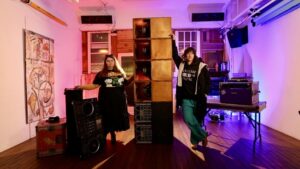
Maia Gold and Sharmaine Spencer with Honey Trap boxes
In late 2023, Honey Trap Sound System was invited to participate in Frames and Frequencies, an international film project commissioned by Sonic Street Technologies (SST) that documents sound communities around the world through moving image. The project brought together filmmakers and sound system practitioners to create locally situated portraits of sound systems and sound communities operating across diverse cultural and geographic contexts.
The series comprised fifteen* films in total. Within Australia, Melbourne’s Heavy Congress, Darwin’s newly emerged “Knock Em Down’” sound system, and Sydney’s Honey Trap Sound System were represented. Internationally, the collection included works from Brazil, India, Colombia, the United Kingdom, South Africa, and Jamaica. Brazil’s Femine Hi‑Fi being the other woman‑run sound system featured in the series.
From Local Origins: A Honey Trap Sound System Story weaves together two narratives. The first follows the emergence of Honey Trap Sound System, a woman-led sound system brand founded by myself (Maia Gold) and co-operated with Sharmaine Spencer. It documents the system’s origins, design philosophy, and day-to-day operation as a portable, organic, small-but-flexible, high-impact sound system. Officially launched on International Women’s Day, 8 March 2021, the brand was created to encourage mentorship and grassroots learning for women in audio on a local scale. The film reflects on our young system’s continually forming identity, alongside the challenges and triumphs of operating in a traditionally male-dominated space.
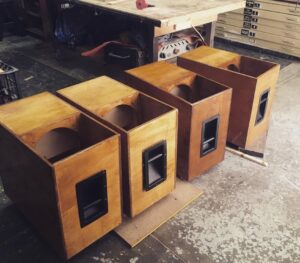
Honey Trap Sound System – in construction, Join The Dots, Marrickville, 2021
Alongside there is a love letter to the local environment that enabled the system’s growth. The video weaves in the textures of Marrickville, an industrial suburb in Sydney’s inner west, situated beneath the flight path and home to a dense and interconnected creative community. Through a nostalgic lens, it loosely maps the crews and collectives that lived and worked alongside one another during what could come to be known as Sydney’s “Collective Era” of music and arts culture (2010–2020).
The film’s soundtrack [1] features predominantly local musicians, with a strong emphasis on local women artists, reinforcing the crew’s broader commitment to representation and community support. Additional archive material was sourced from a collection of local videographers and photographers who have documented the scene, including my own personal video archive. [2]
The story of Honey Trap Sound System is as much a story of women’s determination and friendships as it is a story of Sydney and its ever-evolving spaces and communities. For many years, Sydney was widely perceived as a city lacking accessible and meaningful nightlife. High prices, mainstream programming, and exclusionary social spaces dominated much of the after-dark economy. In response, small groups of dedicated individuals were pushed to the outskirts, working to reclaim the city through DIY parties, informal sound systems, and temporary occupations of place. It is within this punk-ethos, de-monetised party space that Honey Trap Sound System has operated. One of the first statements of the film is: “A sound system moves and shifts just like a city moves and shifts.”
The video was shot rapidly over the Christmas holiday period by Argentinian cinematographer Zoe Ortiz, who had arrived in Sydney one month prior to beginning the shoot. Seeing the community with fresh eyes, Zoe followed Sharmaine and me as we loaded and unloaded between local bump-ins and outs, informal Christmas gatherings, equipment loans and DJ gigs. While Zoe’s journalistic style was central to the video’s visual language, the collaboration extended well beyond production. After this first meeting, Zoe became embedded in the community, forming ongoing friendships with the sound system and its wider network. Relationships were central to the sound system story, which are reflected equally in both the work and the process of making it.
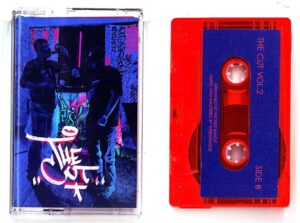
“Artifact” of Australian Hip Hop and Sound System Culture. The Cut – Mixtape Vol.2 (2025) Arranged and Edited by Wicked Bandit, Mixed and Mastered by Threatnique
Sharmaine Spencer acted as co-producer and confidant throughout the edit, describing the filmmaking experience as “transformative — seeing myself represented through the eyes of another.” During interviews, she articulated a desire for the system and her own DJ practice to define and evolve its sound, something that would later be realised through subsequent gigs and events. [3] The new partnership sought to build on the crews that had come before, bringing Dubstep, Hip Hop, DnB, and Caribbean sounds together — with Aussie MCs — creating a unique marriage of Sound System Culture and Aussie Hip Hop Culture. These two genres perform in relatively separate lanes within mainstream Australian music, and continued work was done by Sharmaine through her sound system practice to bring these scenes together. In this way, the film also became an artefact of the creative commitments made to ourselves and the sound system during the process of the edit.
Honey Trap Sound System is situated within a wider ecosystem of sound systems, venues, artists, and organisers that shaped Sydney’s inner‑west scene between 2007 and 2023. Collectives such as Figure8 Collective, Dirty Shirlows, Two Flys, Grounded Sound, Babe Rave, Big Village Records, Foreign Dub, DSS, RPK, Queen Bee, Inner West Reggae Disco Machine and DUNJ are referenced in the film as part of a loose but deeply interconnected cultural fabric. These groups shared not only parties and line‑ups, but also labour, resources, living arrangements, and a commitment to DIY cultural production. While this collective culture migrated to Sydney’s inner west from earlier queer, rave, punk, freeparty, protest and doof traditions of the 1990s — documented by Pete Strong in Do It Ourself Culture [4] — this lineage remains a contextual backdrop rather than the focus.
What remains largely implicit in the film, but alluded to, is the idea that many of these underground sound communities have become victims of their own success. Gentrification, global brand awareness, and what might be described as the “curse of cool” now sit in tension with the covert operations, informal networks, and anti‑commercial ideologies that these scenes were originally built upon. COVID lockdowns and re-openings, as well as Sydney’s high housing costs, have also contributed to a feeling of coming to “the end of an era” for these early collectives. Many operators had become displaced, or at the least, had been struggling to maintain energy and relevance in the cultural and economic environment when the film was made, from late 2023 to 2025. From a practitioner-researcher perspective, documenting this cultural context of the city — on video, with one’s own sound system brand at the centre — intensified the complexities of storytelling, created overlaying research relationships, and exposed ethical responsibilities in global cultural research practices.
The film’s first public screening and Q&A took place in Jamaica in February 2024, alongside other international works from the Frames and Frequencies project. Simultaneously, a live screening was held for a Sydney audience at the Old Geology Lecture Theatre at the University of Sydney. Approximately thirty-five people attended the Sydney screening, after which informal audience interviews were conducted on video to capture immediate responses. Local enthusiasts were fascinated by the international research and the film series. Seeing the first cut of the Honey Trap film presented alongside other international and interstate sound system stories prompted reflection on how Sydney’s music culture is represented within a global context. The Q&A also raised questions around gender and visibility, and how women-run sound systems are read by audiences within a male-dominated cultural arena. Overwhelmingly, the Sydney audience agreed that “there was much more to the story”.
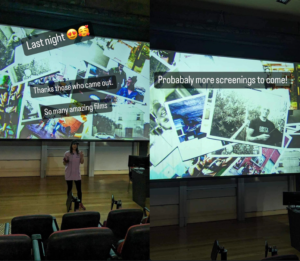
First Public Screening, Old Geology Lecture Theatre at the University of Sydney, February 2024
From a director/editor perspective, the process of seeing the film through an international lens unintentionally enlivened the competitive aspects of sound system culture. After many years of covert, low-risk, “small town” operation, it became painfully clear to me that we really needed to start viewing Sydney as an international city and as a global player. Sydney crews had a responsibility to “Big Up” our own stories and our own culture. And whilst our beloved Marrickville felt like an independent, autonomous refuge within the city, it was doing a disservice to our culture to see ourselves so separately from the wider scene. I personally believe the film would be better represented with more voices speaking on behalf of Honey Trap, and, in general, more voices need to speak up on behalf of Sydney’s immensely rich and authentic DIY music tradition.
Dr. Clair Cooper notes in her introduction to the Australian component of Frames and Frequencies #11 that “Australia is 17,000 kilometres from Jamaica, where sound system culture originates from, and there lies vast distances between each capital city within the country of Australia itself.” This context suggests that, while Australian sound cultures are connected to international trends through travel, modern technology, and media, they nonetheless develop within conditions of relative geographic and cultural isolation. As a result, there are significant differences in how amplified sound is practiced, interpreted, and expressed across local contexts.
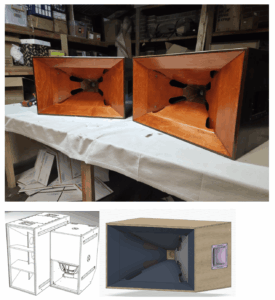
Honey Trap Sound System’s tapped horn TH and multi entry horn MEH design preference
An example of this distinctly “Sydney” evolution of sound culture can be found in the design lineage of the Honey Trap Sound System. Its tapped horn (TH) and multi-entry horn (MEH) configuration reflect a design philosophy shared by many Australian sound systems and “doof rigs,” valued for both their spatial clarity and power efficiency. Grounded Sound System was the first influential Sydney crew to DIY-build this tapped horn design, shaping a broader local aesthetic and technical preference in the scene. [6]
The cutting-edge tapped horn and MEH engineering developed by Americans Tom Danley and Art Welter was originally intended for large-scale religious stadiums and Christian places of worship. This provenance is significant in the Sydney context, where there has long been tension between religious mega-institutions and nightlife culture. In New South Wales, Sydney’s peripheral Hills District is widely known as the birthplace of Hillsong, a highly influential evangelical church corporation with considerable political reach. [7] In 2014, under pressure from Hillsong and broader Christian lobby groups, the conservative government of the time introduced legislation that effectively shut down Sydney’s club scene. This reshaping of the city’s nightlife displaced countercultural practices, which increasingly took root in semi-legal and illegal forms, particularly in Marrickville.
Honey Trap Sound System’s countercultural practice is situated squarely within this tension. By deploying sound technologies originally designed for stadium worship, we can reframe the dancefloor as a site of collective meaning-making—a secular temple. The irony of this uniquely “Sydney” dynamic is not lost on us as operators: we are, in effect, ideologically opposing the influence of the Hillsong church corporation using the very sound systems engineered for their modes of worship.
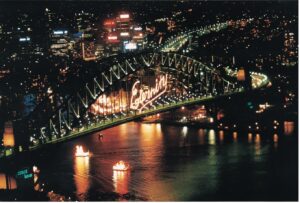
Sydney, 1999 New Years Eve Fireworks “Eternity”
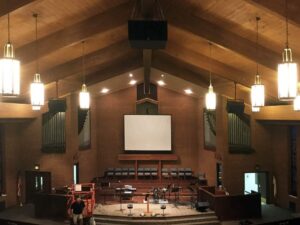
Danley Sound Labs – House Of Worship sound installation.
The 14-minute documentary, too, is crafted with this “stories as a temple” in mind. When I look back on this chaotically put-together film (which in many ways is truly intended for a YouTube and online audience), I can see that the craft of editing, to me, was used more as a musical instrument. I was trying to express and understand something unspoken about my experience of memory, time, and space through geography, rhythm, sound, and moving image. Basquiat said, “Art is how we decorate space; music is how we decorate time.” A sound system, to me, is much the same. It is ephemeral, an ever-changing practice in the collective experience of space and time.
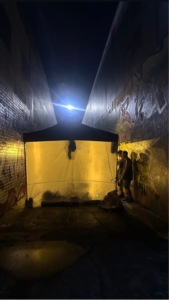
The Secular Temple – Honey Trap Sound System free party, January 2025
If the video or blog post has brought up something for you, please continue the conversation by writing to honeytrapsoundsystem@gmail.com. We welcome your feedback and comments, and particularly encourage the discussions to continue for local & national music practitioners, promoters and supporters.
References:
[1] Spotify Playlist : A Honey Trap Sound System story
[3] “The Cut Vol 2” https://wickedbandit.bandcamp.com/album/the-cut-vol-2-mixtape
[5] Other notable Aussie sound systems with this design lineage are DIY HI FI (Melbourne) and Communify Sound System (Canberra)
[6] Oddly Wholesome, Honey Trap Sound System, RPK – Rabbit Prawn Kollective and DUNJ all crews who owe their Danley design preference to the influence of Grounded Sound System.
[7] Shanahan, Mairead. “’An Unstoppable Force for Good’?: How Neoliberal Governance Facilitated the Growth of Australian Suburban-Based Pentecostal Megachurches.” Religions 10, no. 11 (2019).
About the Author:
Maia Gold is a media artist and entertainment professional working and growing in Gadigal country and Gumbamorra Swamp Land.