
Dubplates and the Presto 6N in Jamaica
The dubplate has been the vital recording medium since the inception of the sound system scene—and even before that. Angus Tarnawsky traces the hidden history of a key instrument in this story, the Presto 6N disc cutting lathe. This particular technology provides an instructive example demonstrating how Jamaican creative imagination repurposed an instrument for recording music into one for creating it. The recording studio in the hands of the great dub producers offers the same lesson. As far as the SST project is concerned this hits the nub of our research: how culture and technology shape each other.
by Angus Tarnawsky
—
Introduction: Dubplates and disc cutting lathes
In Jamaica, a “dubplate” or “dub” is a one-of-one lathe cut record made explicitly for sound system use. This article traces the importance of a specific disc cutting lathe or “dub” machine—the Presto 6N—and details the interwoven connections between audio recording and dubplate production within the broader history of Jamaican sound system culture.
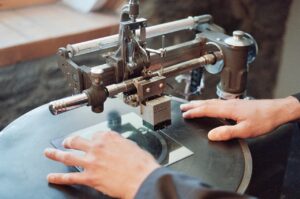
Fig. 1: Close-up of a dubplate being cut (by the author) using a Presto lathe equipped with a mono Grampian cutter-head (a favourite amongst Jamaican dubplate cutters). Image: Ben Lapierre.
While today it may take a considerable amount of effort to even locate a working disc cutting lathe, the act of inscribing sound direct-to-disc was once a remarkably common activity, and disc cutting lathes were a plentiful commodity. This was the case in Jamaica as it was in most places, especially during the electrical recording era of the mid-1920s to mid-1940s. From the late-1940s onwards, however, disc cutting lathes—the machines used to make dubplates—had to evolve to coexist with the widespread arrival of magnetic tape, and due to tape’s innovative features, it quickly became the preferred medium for daily recording purposes. As such, since the 1950s, disc cutting lathes have mostly been utilized by specialized mastering engineers to produce master discs for vinyl manufacturing rather than as a daily recording device by recording or mixing engineers. While engineers of all kinds would occasionally cut reference discs (i.e. the equivalent of a mp3 “rough mix”) it was in Jamaica specifically that such discs would evolve to become dubplates as they are known today.
As older mono disc cutting lathes became obsolete in North America and Europe they found their way to new locations, including Kingston, Jamaica. These sorts of machines—like the Presto 6N—became highly appropriate for dubplate cutting, where it was necessary to have an affordable and easy to use machine that could cut hundreds of discs per week to keep up with local demand. As early as 1946, second-hand portable lathes (around the size of a large suitcase) are documented as being in frequent use across Jamaica [1]. While there were occasional recording sessions in public locations before this date [2], it is fair to say that as a cultural phenomenon in Jamaica, disc cutting arrived most noticeably from the early-1950s. In this respect, the importance of Jamaican contributions to disc cutting is one aspect of a larger history that—until this point—has not been detailed, except in part by Ray Hitchins and in passing amongst many oral histories of reggae compiled in the past few decades [3].
The Presto 6N
Presto was founded in 1915 by George Saliba in Brooklyn, New York. While closed for several years as a result of the great depression, the company reemerged to become the Presto Recording Corporation in 1933. At that stage, Saliba had just published Home Recording and All About It (1932), explaining how audio discs could be affordably recorded by consumers, either in their homes, or at events; musical performances, birthdays, bar mitzvahs, weddings, funerals, and so on. Saliba understood that portable disc cutting could provide audio documentation for a range of activities in a similar way that photography allowed for visual documentation. He was also a keen salesman who was aware of the financial uncertainty of the times. His pitch emphasized how more affordable disc cutting machines could benefit both individuals and small business owners. By the late-1930s, this concept had materialised in a range of institutional as well as informal settings.
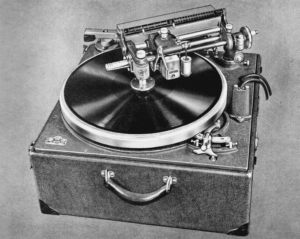
Fig. 2: A Presto 6N in a travel case from the 1940 Presto catalog. Image: Steam Powered Radio.
A consistent model in the Presto catalog across several decades was the 6N semi-professional disc recorder. After being discarded from mainstream commercial use, this low-cost yet reliable lathe went on to play an important role in the development of the Jamaican music industry. The design of the 6N was solid enough although compromised on some aspects of user flexibility and audio fidelity to allow for portability. This was important at the time, since recording to disc often took place “in the field” rather than in a dedicated recording studio. The relative affordability of the 6N (especially second-hand models) meant that small business owners, as well as individuals, could make use of the 6N to cut one-of-one discs as needed in a range of settings. It was precisely these qualities—portability and affordability—that made the 6N well suited to the Jamaican setting, where entrepreneurs like Ken Khouri and Stanley Motta recognised their utility for recording local musicians as well as documenting community life more broadly.
Introduced in 1940 for $440 USD (approximately $10,000 USD in 2025), the Presto 6N was a revision on the already popular 6D model (available since the mid-1930s). Around 1946, Jamaican businessman Ken Khouri purchased a second hand machine while visiting relatives in Miami for $350 USD (approximately $5,000 USD in 2025). By all accounts, this is one of the first lathes to arrive in Jamaica. As a point of reference, a more sophisticated Scully lathe—which was revered at the time for professional vinyl production applications—cost approximately $30,000 USD (cost is quoted in 2025 currency, accounting for inflation). Presto proudly noted in their 1940s sales booklets that over 1,500 6D recorders had been sold (before the discontinuation of the model and upgrade to the 6N). While no clear numbers are available to confirm how many 6N recorders exist, disc cutter and Presto 6N expert Michael Dixon estimates that the company would go on to produce around 5,000 6N units [4].
In the 1950s, Donald Hendry was the main engineer for Stanley Motta; owner of the first recording studio in Jamaica. Hendry claims the lathe he was tasked with operating by Motta—and the first made available for commercial use at a studio in Jamaica—was a Presto “N6” purchased and installed in a dedicated space in the early-1950s [5]. Presto, however, never actually produced a N6 model. In Ray Hitchins’s Vibe Merchants: The Sound Creators of Jamaican Popular Music, Hendry claims the lathe he used looked similar to a widely used British Broadcasting Corporation (BBC) lathe from the time. It is unclear if Hendry was also shown a Presto 6N since it shares a remarkably similar form with the BBC lathe. Nonetheless, based on the fact that Motta was already familiar with Paul Khouri’s portable Presto 6N lathe, it would make sense that Motta would source a similar unit.
Dubplates and Jamaican Sound Systems
By the mid-1950s, sound systems were one of Jamaica’s most important musical infrastructures of popular culture. With limited access to imported records or radio, sound systems emerged as the primary way that many Jamaicans encountered music. Operators such as Duke Reid and Clement “Coxsone” Dodd competed for audiences by playing self-sourced rhythm and blues from the southern United States, supplemented increasingly by locally recorded material. Dubplates produced using machines like the Presto 6N were integral to this process. These records would have contained exclusive content from local artists and producers that was only accessible on a dubplate commissioned or obtained by a sound system operator. In this way, one-off dubplates provided exclusivity: to hear a particular tune at a dance was to witness the sound system’s success (and wealth) in securing and cutting material unavailable to competitors, and, later, bespoke lyrics by a leading artist “bigging up” the sound that commissioned them
Additionally, dubplates were typically cut to have an emphasized bass response (a signature of the Jamaican sound across musical genres), and this would then allow for a particularly bass-heavy playback on sound systems. This is especially the case when compared to commercial releases from other markets, where engineers were far more conservative in how they modified audio sources while cutting. As Julian Henriques notes, dubplates in this way functioned as “sonic weapons,” shaping not only the aesthetic impact of a dance but also the social hierarchies of Kingston neighborhoods [6]. While the technical limits of phonographic records—short side lengths and restricted bass response—certainly shaped how music could be inscribed onto disc, Jamaican engineers and selectors actively pushed disc cutting to its limit, and toward their own ends. In cutting deeper grooves, pushing “into the red” or exploiting distortion for bass emphasis, Jamaican cutters redefined the possibilities of recorded sound. In this sense, dubplates were not just records but experimental sonic objects.
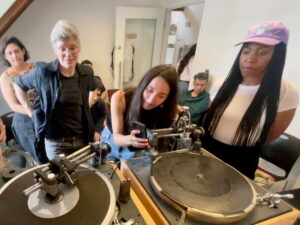
Fig. 3: Observing a dubplate being cut on a Presto 6N. Image: Angus Tarnawsky.
In the 1950s and 1960s, many disc cutting lathes were installed in commercial and private facilities in Jamaica, including a Presto 6N in the home studio of seminal dub producer, Osbourne “King Tubby” Ruddock [7]. Leading up to this point, Jamaican music entrepreneurs like Ken Khouri, Stanley Motta, and Ivan Chin had all used 6Ns, recording important social events such as weddings and funerals, as well as providing their services to select local musicians at ad-hoc recording studios consisting of a single microphone connected to a disc cutting lathe [8]. In a matter of years, the manufacturing of dubplates featuring local artists became big business in Jamaica. As an engineer at Kingston’s Federal Records in the 1950s, Graeme Goodall recalls how he would cut dubplates “on this old mono lathe” (a Neumann AM32B). He notes that prior to the Saturday night dance, “Friday was the dub day” [9] and shares that on one particularly busy Friday, he cut “185 double-sided ten-inch records” [10].
Over time, aspects of the dubplate cutting process began to influence other emergent audio production practices, such as dub audio (re)mixing. In that particular instance, dub evolved rapidly because once a mix was cut onto a dubplate, it could then be played out on a sound system (to assess whether the chosen production techniques excited both loudspeakers and audiences) and then modified accordingly, before repeating the process for further testing. This back-and-forth of trial-and-error to account for translation between studio and stage is still a valuable approach for artists and engineers working today with wholly digital processes (i.e. a mix always feels different on stage when compared to a controlled studio environment). In this respect, by preparing and optimizing mixes for sound system playback, producers like King Tubby treated disc recording as a live performance on an “instrument,” much in the same way that all dub producers since have used mixing consoles, tape machines, and effects processors as “instruments” [11].
Conclusion
The trajectory of instantaneous disc cutting in Jamaica demonstrates how so-called obsolete technologies are never simply abandoned, and rather, demonstrates how older audio equipment can be consistently re-animated in new social and cultural contexts. Although semi-professional disc cutters like the Presto 6N were displaced by magnetic tape, in Kingston, Jamaica, these same machines became essential within a new sonic economy. What North America and Europe discarded as outdated would be transformed in Jamaica into altogether new ways of hearing sound. In many ways, the Presto 6N remained relevant in Jamaica because of local conditions: the high cost of imported records, the late arrival of regular radio broadcasting and the centrality of sound systems as everyday infrastructures of music distribution. Dubplates in this context functioned as both exclusive commodities and experimental artifacts.
The material constraints of disc cutting also shaped the aesthetics of Jamaican popular music. Engineers like Graeme Goodall recalled how bass intensity had to be carefully balanced on discs, with tracks rarely exceeding three minutes if they were to remain playable [12]. In this way, as dubplates ventured further from Westernized “best practices” to Jamaican informed “best sounding practices,” they shifted disc cutting lathes from being passive inscription devices into instruments of experimentation, shaping how basslines were cut (and heard), how vocals were stripped (or emphasized) and how sound systems competed (and in part, determining the winners and losers in these competitive meetings). In many ways, King Tubby extended these practices to their limits as he pioneered the process of (re)mixing content directly onto disc for sound system use. Tubby’s work demonstrates how technologies reveal their possibilities when pushed to their limits; he treated the Presto 6N not merely as a device of sonic reproduction, but as a generative machine, using it to distribute his innovative dub (re)mixes that destabilized conventional listening practices by foregrounding experimental sonic processes.
Notes
[1] Neely, 2007, p. 3.
[2] These “hot wax” cutting sessions were held in public locations in 1934 by Eugene Finzi and H. Dewar Gray (Lowe, 2020, pp. 106–107).
[3] Hawks and Floyd, 2021; Katz, 2003; Lowe, 2020; Veal, 2007.
[4] Evans, 2025, p. 58.
[5] Hitchins, 2014, p. 10.
[6] Henriques, 2011, p. 93.
[7] According to Tubby’s first apprentice, Philip Smart (2003, quoted in Veal, 2007, p. 112), the 6N was obtained from sound system operator Duke Reid’s Treasure Isle studio.
[8] Hawks and Floyd, 2021, pp. 21, 23, 25, 33, 82.
[9] Goodall quoted in Hawks and Floyd, 2021, p. 90.
[10] Goodall quoted in Hitchins, 2014, p. 87.
[11] Veal, 2007, p. 117.
[12] Goodall quoted in Hawks and Floyd, 2021, p. 93.
References
Evans, Scott. 2025. “Mid-Fi: Cutting Plastic Records with Michael Dixon.” TapeOp 165 p. 56-60.
Hawks, Noel, and Floyd, Jah. 2021. The Birth of Ska: From Mento to Studio One. Jamaican Recordings Publishing.
Henriques, Julian. 2011. Sonic Bodies: Reggae Sound Systems, Performance Techniques, and Ways of Knowing. Continuum.
Hitchins, Ray. 2014. Vibe Merchants: The Sound Creators of Jamaican Popular Music. Ashgate Publishing.
Katz, David. 2003. Solid Foundation: An Oral History of Reggae. Bloomsbury.
Lowe, Rich. 2020. The Matador: Lloyd Daley, Sonic Pioneer of Jamaican Music (Revised ed.). Jamaica Way Publishing.
Neely, Daniel. 2007. “Calling All Singers, Musicians and Speechmakers: Mento Aesthetics and Jamaica’s Early Recording Industry.” Caribbean Quarterly 53 (4) p. 1-15.
Veal, Michael. 2007. Dub: Soundscapes and Shattered Songs in Jamaican Reggae. Wesleyan University Press.
About the author
Angus Tarnawsky is a researcher whose work draws on sound system cultures in Canada, Jamaica and the UK, incorporating dubplate cutting, place-responsive audiovisual performances and the investigation of dub as a sonic-spatial research methodology. He is currently a Social Sciences and Humanities Research Council (SSHRC) Postdoctoral Research Fellow in the School of Music at the University of British Columbia.