
Cumbia sin Reglas: A cross-border multimedia event
This week’s post is the first in a series of three documenting the work of SST California researchers Paulina Lanz and Fernanda Soria-Cruz. In the spirit of the SST blog, they have taken up the project’s invitation to approach the blog from a personal angle, documenting their research process rather than anticipating the findings they will present in the forthcoming Mobile Music Machines book series. This post recounts a multimedia event on cumbia music and culture hosted at the Hammer Museum, and the initial questions it raised as they began their research into sonidero culture in the US in 2023.
by Fernanda Soria Cruz and Paulina Lanz Garcia
“Cumbia might be the sound version of mezcal.” Cultural historian Josh Kun offered this metaphor near the end of Cumbia sin Reglas, a night of film, conversation and dancing at the Hammer Museum in Los Angeles on October 26, 2023. Like mezcal, cumbia carries the taste of a specific place, yet it travels and in doing so, it becomes something new wherever it is shared. The image sums up what that evening taught us: cumbia is at once deeply local and while insisting on being borderless.
We attended as researchers of the Sonic Street Technologies (SST) project. As part of the US team, we wanted to identify and document the diasporic sound of cumbia. Did cumbia have a distinct sound when taken to LA? Who were the artists involved? What did they value? What was the role of the community in keeping the sound alive? Why cumbia? And what were the affordances of the genre? These were just a few questions we brought to the event. For both of us, it was one of our first steps into sonidero research. As Mexican researchers born and raised in two sonidero centers (Mexico City and Puebla), we understood the cultural relevance of cumbia sonidera, yet our experiences had been peripheral up to that point.
Beginning to study this field meant learning to listen, see, and even dance differently: paying attention not simply to records and speakers, but to the people, practices, neighborhoods, and migrations that carry them.
Sonidero culture, the Mexican tradition of mobile sound systems whose DJs (sonideros) mix cumbia and tropical music and send spoken saludos (shout-outs) across the dance floor, grew out of Mexico City barrios such as Tepito and nearby states like Puebla, and traveled north with Mexican migration. In California it lives in backyard parties, dance halls, bars and online collectives, with Los Angeles as a key hub. And so, we learned our first lesson: the sonidero culture in LA has its own sound, identity, and discourse, one that is nevertheless in constant conversation with its roots in Mexico. Cumbia sonidera allows for both, keeping tradition going while claiming its own identity outside of the country.
The fact that this celebration took place at the Hammer mattered. Run by UCLA in Westwood, the Hammer is one of the city’s leading contemporary art museums, and its public programs are free. That same year, the Made in L.A. 2023: Acts of living featured Más Éxitos, the Los Angeles cumbia collective founded by one of the evening’s panelists, Gary Garay, an LA-based mixed-media artist, DJ, and record collector. Bringing party culture into a museum signaled recognition, but, as the title promised, on the scene’s own terms. Cumbia sin reglas, cumbia without rules, named both the genre’s openness to mixing and an evening that refused to separate screening from creative exchange, or creative exchange from dancing.
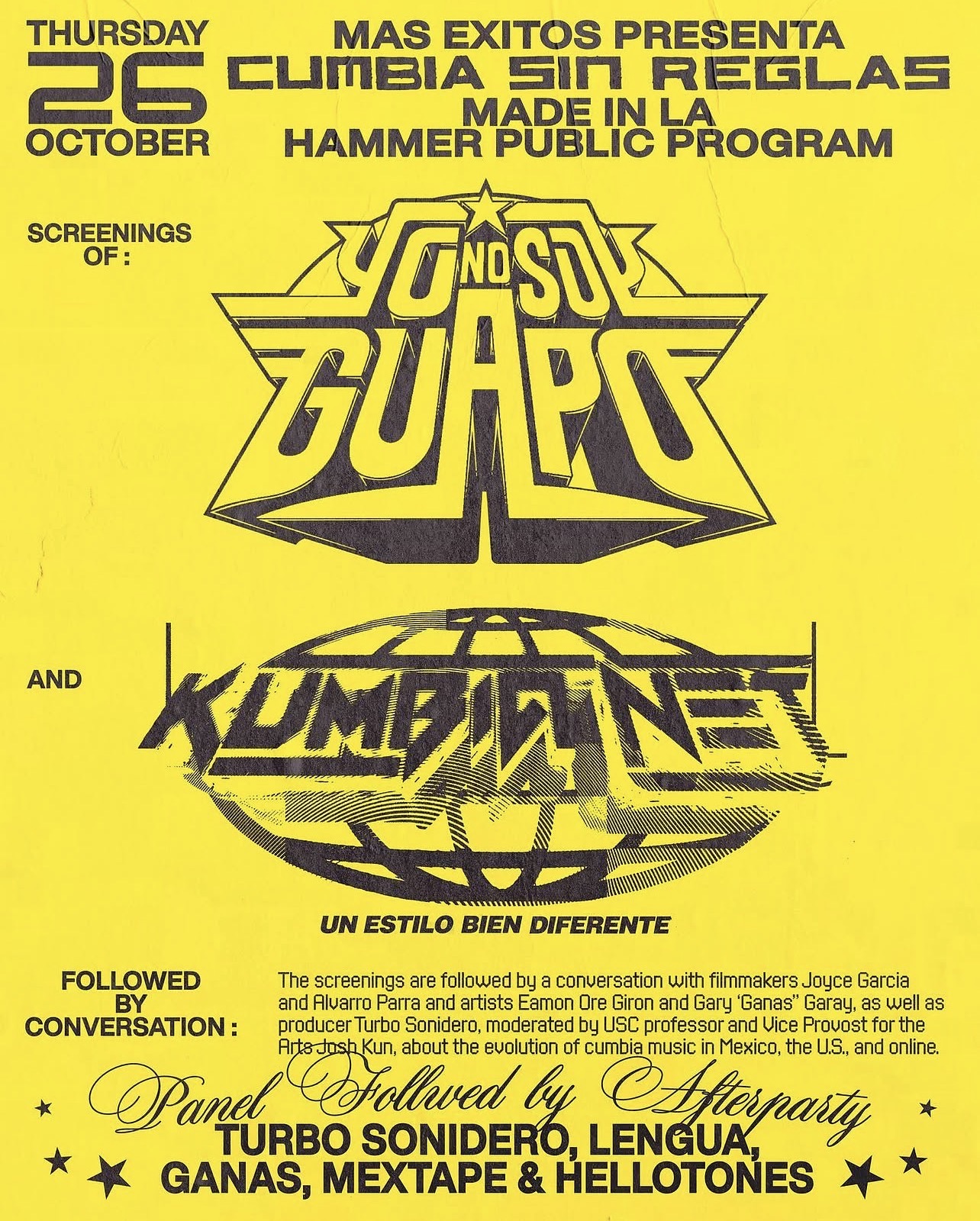
Event flyer. n/d, Image by the authors
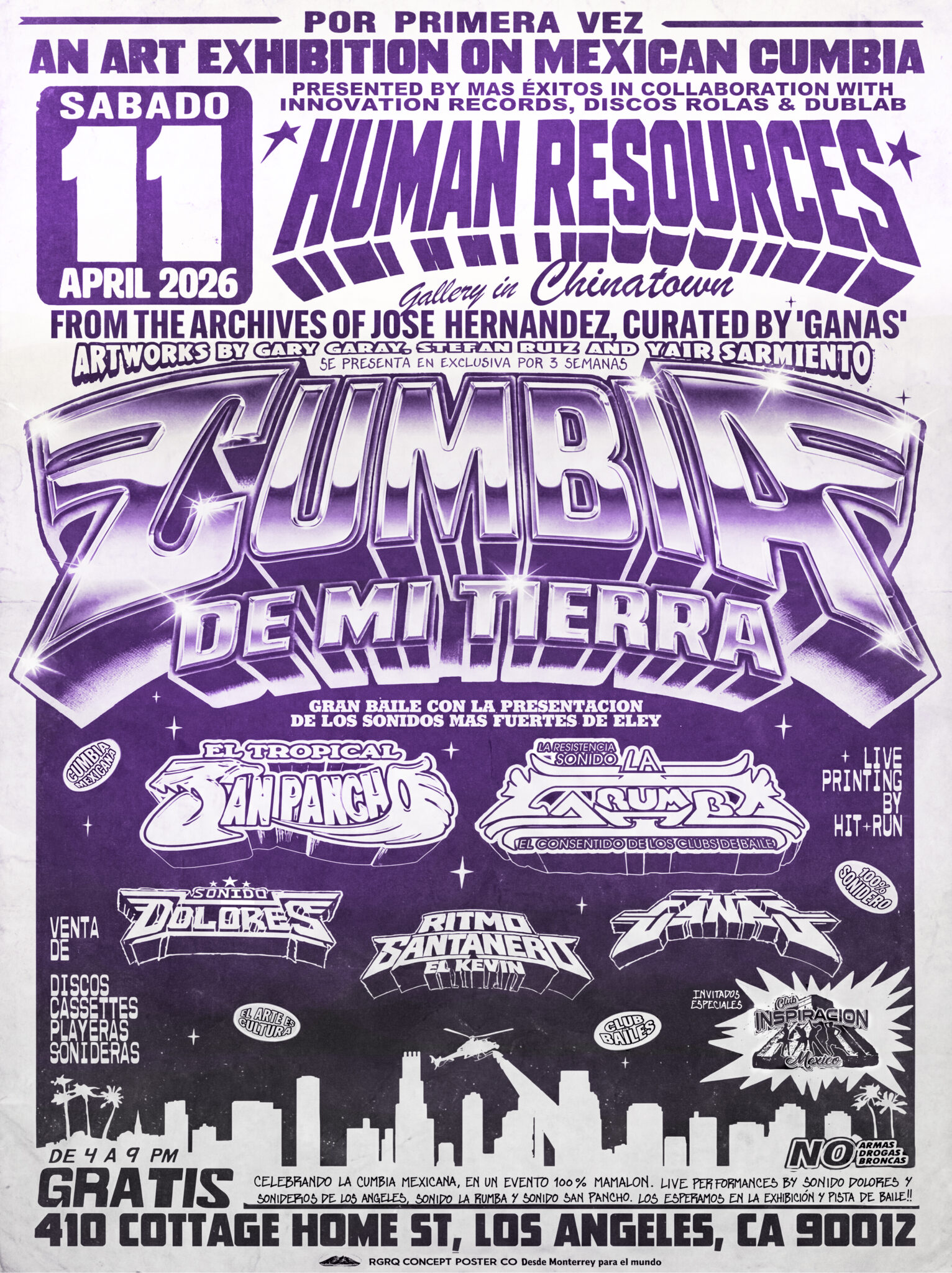
Cumbia de mi Tierra Poster. Credits: RGRQ CONCEPT POSTER CO Desde Monterrey para el mundo
Two films, two cities
The evening opened with two documentaries. *Yo No Soy Guapo* (2018), directed by Joyce García, follows Mexico City sonidera Lupita “La Cigarrita” through the streets of Tepito as she guides us through sonidero history and the people who built it. It shows how sonideros create community for working-class youth facing discrimination, policing and displacement, and how migration has shaped the movement (see an interview with García by Leo Vidigal previously published on this blog).
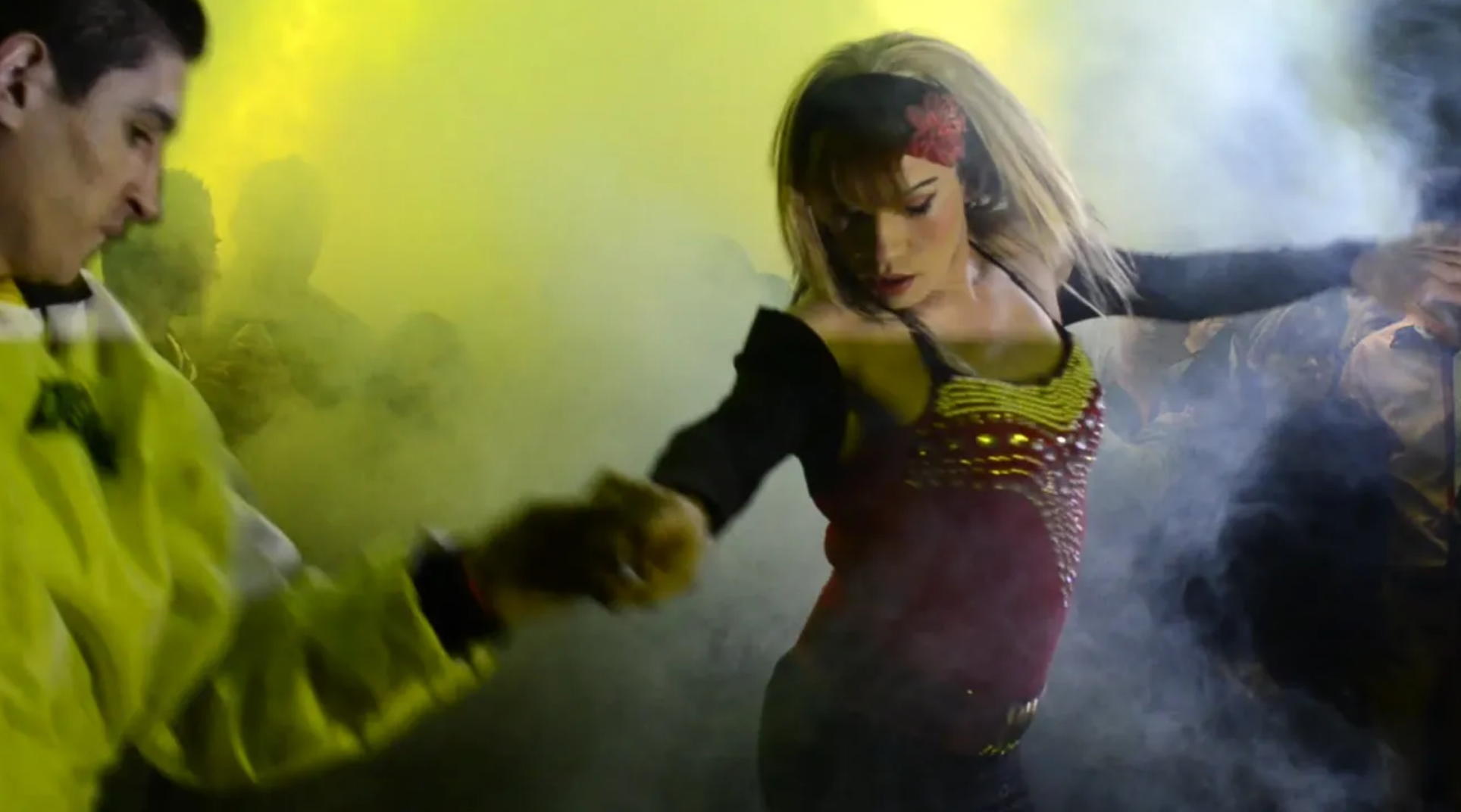
Still from Yo No Soy Guapo documentary, dir. Joyce García, 2018
*Kumbia Net: Un Estilo Bien Diferente*, directed by Álvaro Parra, follows the Kumbia Net collective, producers and DJs from Mexico and the United States who met online, swapped sample packs over WhatsApp and SoundCloud, and built a dark, sample-based sound rooted in Mexican sound system culture, often called kumbia obscura (listen here) . Its members have met in person only a handful of times; the film follows them from Puebla, San Luis Potosí, Mérida and Querétaro to Los Angeles and the Bay Area. Parra, whose earlier film Sonidero Metropolis portrays Puebla sonideros working in Los Angeles, told the panel that showing artists at their decks, with the technology in their hands, was for him both essential and beautiful.
Side by side, the films showed two routes into the same world: García’s street-level portrait of a Mexico City tradition, and Parra’s map of a network that exists as much on phones and servers as on dance floors. Both treat cumbia as more than a genre: a form of expression, resistance, and belonging. The documentaries show how digital media and the internet have enabled new forms of cultural production and dissemination, as well as new forms of participation and interaction among audiences.
Sonido sonidero: a conversation
After the screenings a conversation panel was held. Three themes ran through it, moderated by Kun: what cumbia actually is; why place matters on both sides of the border; and how gender has shaped who gets seen in sonidero and cumbia scenes.
Asked to define cumbia, visual artist and collector Gary “Ganas” Garay described it as “a thing, a genre, a sound, a rhythm that sacrifices itself to whoever wants to partake in it”, whether to change it, make it, explore it, or simply enjoy it. Artist Eamon Ore-Giron, known in the scene as DJ Lengua, called cumbia his Southern Constellation, the reference that orients “my taste […] and the way I will see the world.” Meanwhile, Parra stressed its emotional range:
You can listen to cumbia because you’re really happy. You had a wonderful day. Maybe you just got paid, and you want a party. […] You could also listen to cumbia because you’re really depressed. Somebody just broke up with you. Maybe you lost your job, pero voy a escuchar unas cumbias de todos modos [but I’m going to listen to some cumbias anyway].
What struck us is that none of these definitions was about musical form. Each described a relationship: cumbia as something you give yourself to, navigate by, or return to in joy, sadness and in grief.
Filmmaker García expanded the frame to other sounds that feed Mexican sonidero culture, from salsa and Caribbean music to Colombian and African rhythms, reminding us that every sonidero sound carries a geographical history, one that is never static and connects place with people. For her, those sounds are “a feeling. It starts in the body […] in the heat, in the sweat.” She then quoted La Cigarrita:
A sound system is like an orgasm. […] You feel it in your bones, in the skin, with your partner, or if you are alone, with your homies, you know. So, it’s like a community. It’s a feeling. […] For me, it is liberty, freedom.
La Cigarrita’s words moved the discussion from the head to the body: before cumbia can be theorized, it is felt through skin, heat and bass. Coming from a woman who has held the microphone in a male-dominated scene, her link between pleasure and freedom also read as a political claim, one that the conversation on gender would return to.


Panel on stage. From left to right: Cultural historian Josh Kun (moderator), Cumbia Producer Turbo Sonidero, Filmmaker Joyce Garcia, Kumbia Net Director Álvaro Parra, Eamon Ore-Giron “DJ Lengua” and Gary Garay “DJ Ganas” 2023, image by the authors
Sound and place
If cumbia’s origins are plural, so are its places. García described the sonic gentrification of Mexico City’s key sonidero neighborhoods, and Parra noted the same forces at work in Los Angeles (see this previous post on the struggle over spaces to play). Turbo Sonidero, a San Jose producer and co-founder of Kumbia Net, argued that “where you are from influences the kind of sound that you make. It is like a product of your environment.” Ganas saw it differently: through cumbia, “you’re not necessarily clicked into a certain place […] Almost like this is all our place. Like all the Americas are ours and all these sounds are ours.”
The two views pull in opposite directions. For Turbo, sound carries the mark of where it is made and insists on that place; for Ganas, cumbia turns a whole continent into home. We came to see these not as contradictions but as two halves of the diasporic experience: holding on to a specific origin while claiming belonging everywhere the music goes. Ganas described Más Éxitos in exactly those terms, as a community and a family, a platform for collecting records and “listening to migration patterns in audio.” Every panelist returned at some point to family histories of migration: a cumbia made in the present but full of longing for the past, a past that is honored without being frozen.
¿Cómo dices eso? Crossing linguistic borders
The evening revealed many borders that cumbia crosses: between countries, between modes of production and archiving, between classes, genders and races, and between visible and hidden histories. Discussing gentrification in Tepito, García paused mid-sentence and switched to Spanish: “¿Cómo dices eso?” (How do you say that?). The audience laughed in recognition. She kept going, moving between languages again and again without losing anyone. “Perdónenme, me pongo nerviosa” (Forgive me, I get nervous), she apologized. People applauded and nodded, and a voice from the back said what the whole auditorium felt: “We get you.”
For us, this was the moment the evening stopped being an event we were observing and became one we were part of. The crowd of artists, families, friends, scholars and neighbors was as mixed as the music, and García’s code-switching felt less like a slip than like the most honest way to speak about a culture that lives in two languages and places at the same time. Anzaldúa wrote of “speaking in tongues” as a source of strength for women writing from the margins. [1] For us, García’s code-switching resonated with Anzaldúa’s attention to language and writing from the margins. The audience’s response made linguistic crossing feel less like a barrier than a shared practice of listening. Here, an audience of atravesados [2] in Anzaldúa’s terms–those who live across borders–showed that it knew exactly how to listen.
Women at the front of the sound
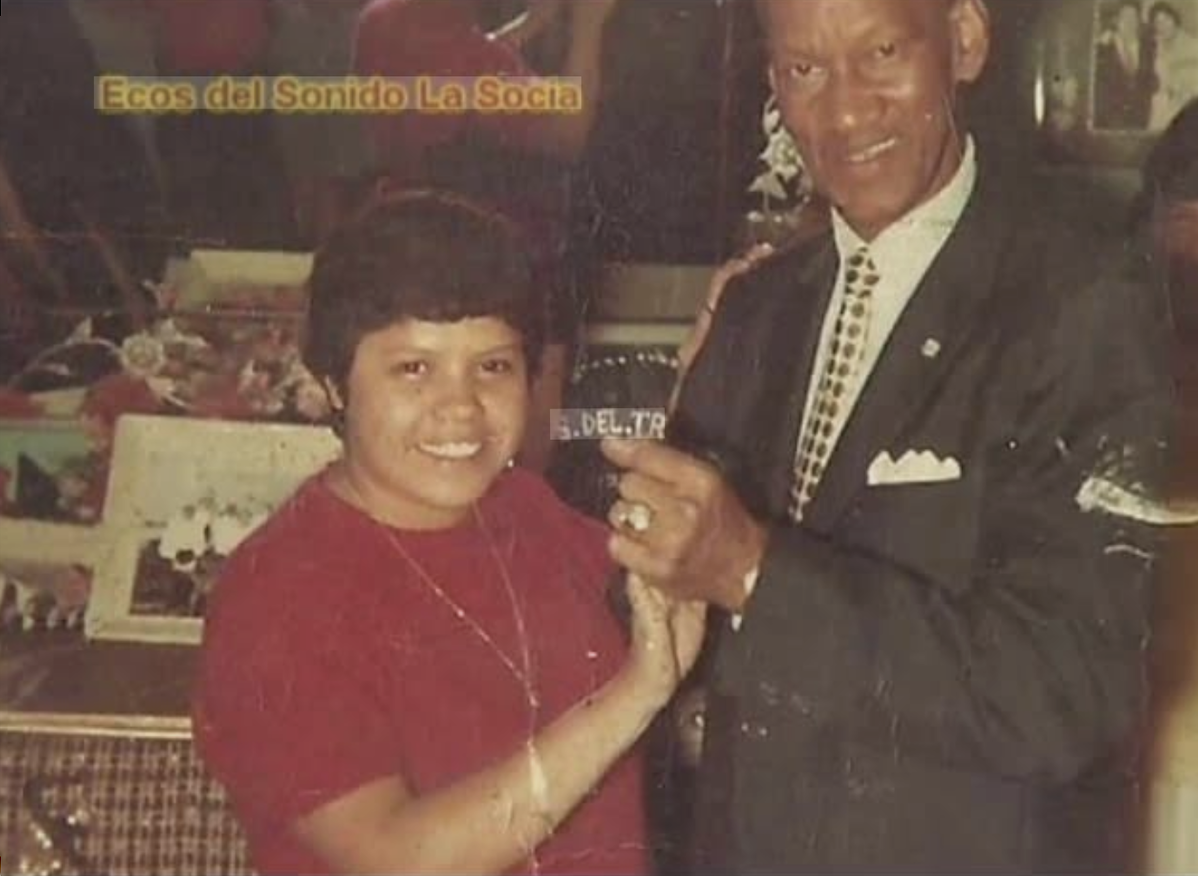
Still from La Socia, n/d, image taken from Fonoteca Nacional de Mexico, Sesión de Escucha La Socia, Primera Sonidera, Youtube
Kun then turned to the matriarchal portrait of cumbia in Yo No Soy Guapo, opening a discussion of gender in sound system cultures. García insisted that women’s presence is not new:
“Ellas siempre han estado ahí [They have always been there]. The women in sound system and sonidero culture have always been there […] like the wives of the big sonideros: they were buying the music, they were playing it, they were taking care of their family while the men performed in the front. They couldn’t have done it without the help of the women.”
She pointed to La Socia as an example of that erasure: the teacher of the celebrated Sonido La Changa, yet rarely heard of, because the scene is machista and many women have been invisibilizadas (made invisible). According to Musas Sonideras founder Marisol Mendoza, La Socia became Mexico City’s first sonidera in Tepito in 1965. García also celebrated Musas Sonideras, the collective active since 2017 that works to connect and make women sonideras across Mexico visible. In García’s words, “están uniendo todo el pedo” (they are bringing all of it together). Then, laughing: “No sé qué estoy diciendo, estoy hablando súper mal” (I don’t know what I’m saying, I’m speaking so badly). Once again, the audience understood her perfectly.
Three years on, we can see all the results of women’s efforts to claim space in the scene. Musas Sonideras has brought around 20 new sonideras into the scene through its own training, and its Musafest now fills one of Mexico City’s most famous dance halls. Her branches, including the one in the United States, have offered presentations across the country in historic latin venues, and in collaboration with USC in Los Angeles. Sonideras have also taken their sound systems into public protest, accompanying 8M women’s marches and families searching for Mexico’s disappeared. The story La Socia never got to tell is now being written by the women who followed her.
Much has changed since 2023. That year, Mexico City recognized sonidero culture as part of its intangible cultural heritage. In July 2026, the feminist Mexican collective Musas Sonideras held the ninth edition of its Musafest at the historic Salón Los Ángeles in Colonia Guerrero, Mexico City, with 50 women taking over the booth. Also, Álvaro Parra’s Kumbia Net, shown at the Hammer as a 25-minute cut, has since grown into a 56-minute feature (2024), and this spring of 2026, his films screened again in Los Angeles during Cumbia de mi Tierra, an art exhibition on the material culture of Mexican cumbia. The conversations we heard that night now read like early notes on these developments.
After the rules
The night closed with a dance party led by DJs Lengua, Ganas and Turbo Sonidero with MC Mextape. These are not the famous dynastic sonideros of Mexico City, but key figures of a newer, diasporic generation: Lengua and Ganas as founding members of Más Éxitos, and Turbo Sonidero as one of the architects of kumbia obscura. On the dance floor, the panel’s ideas became movement.
What does the evening tell us about sonidero culture today? First, that its status is changing: a practice once confined to streets, salones and backyards now circulates through museums, heritage lists and online networks. That recognition is valuable, but it arrives alongside the gentrification that pushes these communities out of the spaces where the music was born. Second, that Mexico City and Los Angeles are not center and periphery, or original and copy, but points on a shared circuit where sounds, records, samples and people move both ways. Kumbia Net’s WhatsApp sample packs and García’s Tepito are part of the same story.
For our research, Cumbia sin Reglas shifted our attention from sonidero culture as a Mexico City tradition to sonidero culture as a transborder network, and from what cumbia sounds like to what it does for the people who gather around it. These insights had a transformative force within our research on diasporic sonidero culture, and made us explore official events at the Mexican Consulate celebrating sonidero culture with the same curiosity as we explored backyard sonidero parties in south LA. The gendered aspect of the sonidero scene became a highlight of our work, a thread that took us to the Musas Sonideras USA, and their collaboration networks with key figures such as Sonido Kanela. We left the event thinking that Cumbia may well be the sound version of mezcal, as Kun mentioned. It is all at once: rooted, strong, revolutionary, made to be shared and it tastes like home.
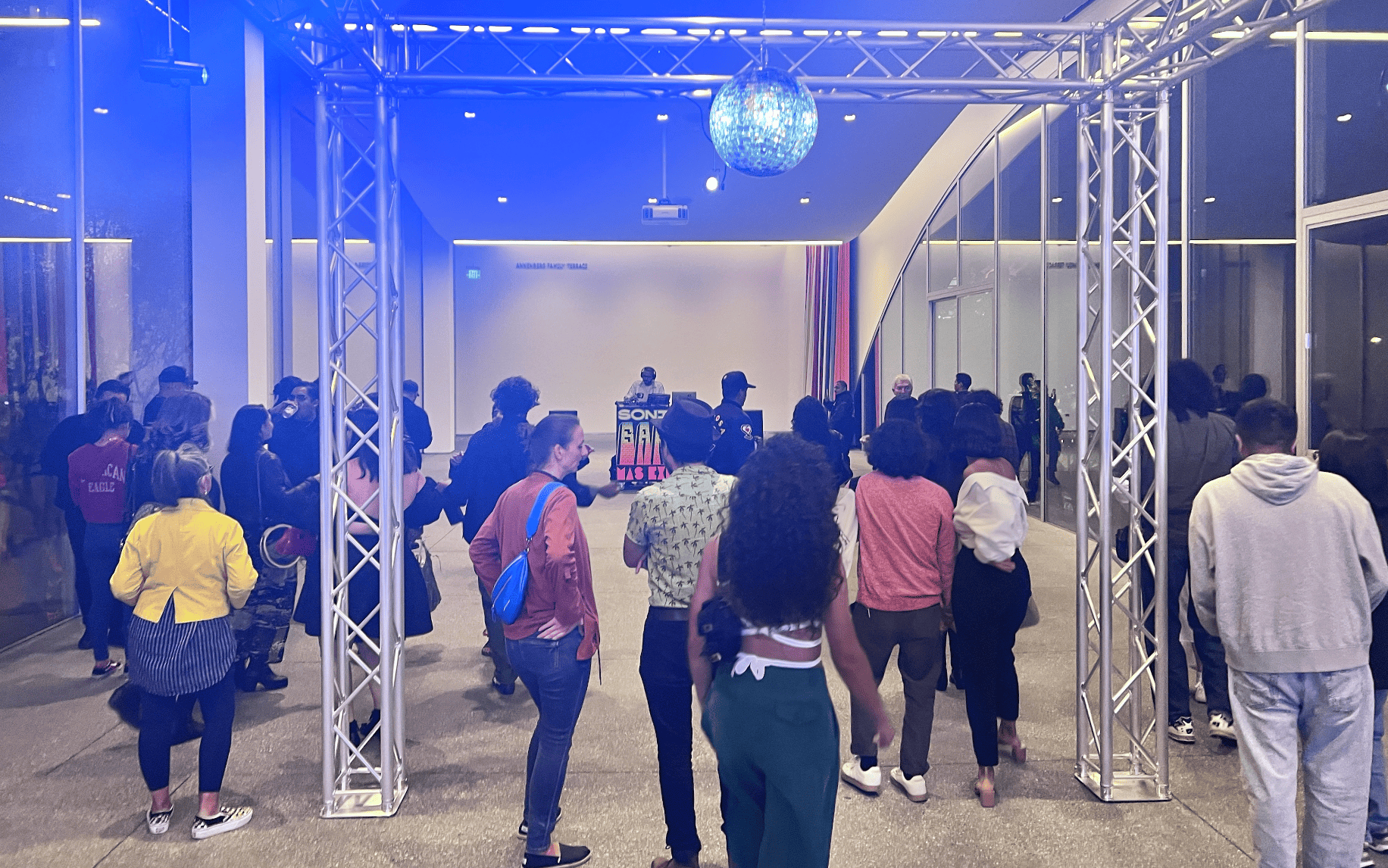
Afterparty / dance floor. Image by the authors
Watch the full panel discussion on Hammer Channel.
NOTES:
[1] “Speaking in Tongues: A Letter to Third World Women Writers,” in This Bridge Called My Back: Writings by Radical Women of Color, ed. Cherríe Moraga and Gloria Anzaldúa (Watertown, MA: Persephone Press, 1981), 165.
[2] Gloria Anzaldúa, a foundational thinker of Critical Border and Chicano Studies, conceptualizes the border as “an open wound”, a site where cultures meet and crash, producing a third culture, a border culture. Their work call border subjects “los atravesados”, those who are transversed, implying spatial dislocation of those who do not fit. Gloria Anzaldúa, Borderlands/La Frontera: The New Mestiza, critical ed., ed. Ricardo F. Vivancos-Pérez and Norma Elia Cantú (San Francisco: Aunt Lute Books, 2021), 56-57.
About the authors:
Fernanda Soria-Cruz is a doctoral candidate in Communication at USC Annenberg. She studies forced disappearances in Mexico, and works with collectives of searching mothers (madres buscadoras) documenting their testimonies and activist efforts,
Paulina Lanz Garcia is a media scholar and educator researching migration, visual culture, and digital archives. Her work explores how media and material objects shape narratives of borders, displacement, and everyday belonging.