
Mobile Music Machines: Call for Chapters
The Sonic Street Technologies (SST) European Research Council project invites chapter contributions to the Mobile Music Machines, an interdisciplinary book series. We have organised contributions so far geographically; they cover sound system cultures in Jamaica and diaspora, Spanish-speaking Latin America and Brazil with a global first volume. The chapters each explore relationships between technology, culture and power through one or more specific case studies. Contributing authors are invariably locally based as either researchers and/or practitioners.
Background
The Mobile Music Machines series explores the social, cultural, political and epistemological dimensions of technologies of sound reproduction, with particular attention to the ways in which these technologies are developed, appropriated and transformed through street and community-based music practices. Jamaican sound systems, Brazilian aparelhagens, Mexican sonidos and Colombian picós are among the key examples of the cultures and practices that the series describes as Mobile Music Machines. We work at the intersection of Cultural Studies, Popular Music Studies, and Science and Technology Studies (STS). Contributions so far are outputs from the Sonic Street Technologies (SST) research project: https://sonic-street-technologies.com
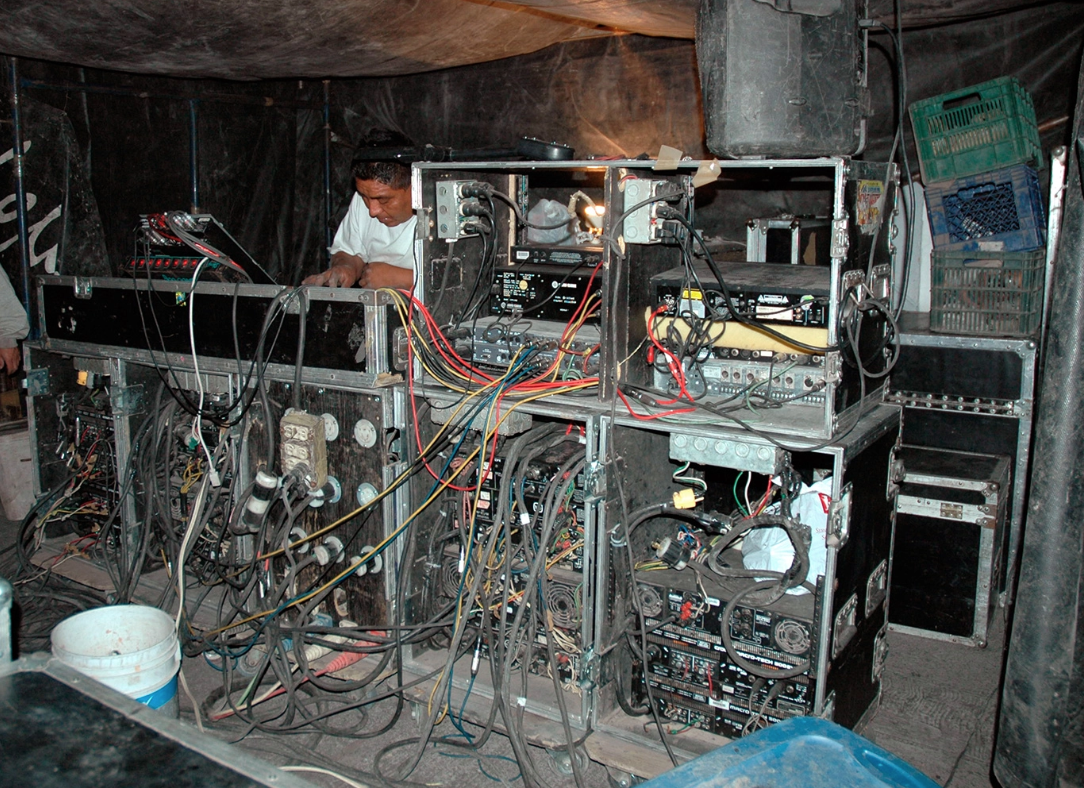
Mexican sonidero operating the set
Technology and Techniques
At the centre of Mobile Music Machines is an interest in sound technologies themselves: loudspeakers, amplifiers, mixers, turntables, playback systems, recording and transmission technologies, and the material infrastructures through which they operate. The series considers how such technologies are built, modified, repurposed, customised and maintained, and how their technical possibilities are shaped by the cultural contexts in which they emerge. Focusing on technological infrastructure rather than the music played enables the development of a shared framework for understanding the relationship between popular culture, technology and society across different contexts.
A particular concern is the knowledge embodied in these practices and techniques. The series explores the techniques, expertise and ways of knowing developed by engineers, selectors, DJs, sound operators and other practitioners, asking what their situated, embodied and often tacit forms of knowledge can contribute to broader understandings of technology. In doing so, Mobile Music Machines takes seriously the epistemological value of practice-based knowledge and challenges conventional distinctions between technical expertise, cultural practice and epistemic knowledge.
Politics
The series also explores the politics of sound generated through these technologies and practices. Sound reproduction is not simply a means of transmitting music: amplification, frequency, volume, spatial organisation, mobility and access all have social and political consequences. Mobile music machines create spaces for collective identity, cultural expression, economic activity and community empowerment, while also providing ways of negotiating power, exclusion and belonging and reshaping the public space.
Through these perspectives, Mobile Music Machines investigates how sound technologies can help us address questions of race, ethnicity, gender, class, identity, place and diaspora, as well as the broader relationship between technology and society. It considers how communities use and transform technologies to claim space, affirm identities, sustain livelihoods, transmit knowledge across generations, develop new cultural forms and challenge oppressive structures.

Picó el Imperio, Cartagena, Colombia (Instagram @elimperiomip)
Methodologies
The series adopts an interdisciplinary and practice-oriented approach, bringing together ethnographic, historical, cultural, and practice-based research. It privileges local and situated authorship and seeks to foster non-extractive research relationships, recognising practitioners as knowledge producers. We welcome collaborative works from local authors foregrounding the voices, perspectives and expertise of communities and practitioners that have often remained at the margins of conventional histories of technology and popular music.
We are particularly interested in contributions addressing:
- Technological developments, innovation and adaptation, including how practitioners develop, modify, repurpose and customize sound technologies in response to challenging cultural, social and economic conditions.
- Gendered perspectives and women’s involvement, including women’s roles as selectors, DJs, engineers, sound operators, organisers and cultural producers, and how they navigate and reshape traditionally male-dominated cultural practices.
- Political repression, stigma and struggles for legitimacy, including the regulation, criminalisation or marginalisation of sound system cultures, and how practitioners and communities negotiate institutional power and claim recognition.
- Queer and LGBTQ+ scenes, communities and spaces, including how mobile music machines can create spaces for queer expression, belonging and collective identity, and how queer practitioners negotiate existing gender, sexuality and power structures.
- Noise, public space and regulation, including noise abatement, public nuisance, conflicts over the use of public and private space and the broader right to the city.
- Generational dynamics and intergenerational transmission, including how different generations inherit, transform and negotiate established practices, technologies and forms of knowledge, with particular reference to women’s shifting role.
- Business models and value production, including formal and informal networks of production and distribution, piracy and music circulation, and how practitioners generate and negotiate economic and cultural value under precarious conditions.
Given the broad geographical scope of the series, we particularly welcome contributions focusing on the following scenes and areas, and engaging with the themes outlined above:
-
- Sonidera culture in Mexico (excluding the United States)
- Queer, LGBTQ+, FLINTA reggae and dancehall sound systems
- Picotera culture in Colombia, particularly in Barranquilla, the Insular Colombian Caribbean and the Colombian diaspora
- Sound system culture in Africa, particularly in South Africa, Gambia, Senegal and Ethiopia
- Car sound system cultures, including Dominican Republic’s Chipeo and Puerto Rico’s Voceteo
- Minitecas in Venezuela
- Sound system cultures in China, Oceania, Japan
Chapters must be no more than 8k words, plus notes, bibliography and references. They must be based around original fieldwork and include quotes from research contributors, as well as four to five copyright-free images.
Mobile Music Machines will be published in English; submissions are welcome in both English or Spanish for chapters focusing on Spanish-speaking scenes.
Please get in touch with any questions and/ or a 300 word outline of the chapter you’d like to write and your CV.
Emails to sonicstreettechnologies@gmail.com with “Mobile Music Machines chapter proposal’ in the subject line.