
Sound System and Community Radio in Bochum, Germany
SSO is pleased to announce the initiation of a new research project in Bochum, Germany. The research period in the field kicked off at Cute Community Radio on 17th June. Julian Henriques and Brian D’Aquino gave a talk Sound System Cultures: Knowledges and Practices followed by a vinyl session from Brian. This resulted from Guy Dermosessian having contacted SSO, inviting us to collaborate on a sound system and radio event in October. With the local interest in hip hop and sound systems he was inspired by SSO#11. Several online conversations convinced us of the truly remarkable work he was doing with the diasporic communities in the city and with Ruhr University Bochum. SSO is very fortunate to have recruited Dr Thomas Zacharias as lead researcher on the project. Thomas is a German-born lecturer at Goldsmiths with research interests in diaspora and the racialization of German politics. In what follows, in line with our commitment to non-extractive participatory methodology, Thomas provides some background to the Ruhr region from his family connections.
By Thomas Zacharias
It’s June 2026 and I’m travelling north on an ICE train from the southern state of Bavaria to the Ruhr valley in the state of North Rhine-Westphalia. It is an unusual journey, since I am not travelling from my home and workplace in London, but from Munich.[1] This is because I have recently obtained a part-time position with the district youth council in Dachau, working with marginalised young people while also exploring the practices and strategies of a local anti-racist activist group for a research paper.
As a German who has lived the majority of my life in the UK, I experience my stints of ‘being back’ as fascinating, if not at times strange – oscillating in peculiar ways between an insider and outsider positionality. While I have spent my youth here and speak the language, I am frequently out of sync with the nuances (or their absence) of culturally coded social interactions. The delicate dance of exuberant politeness and small talk which I have cultivated over the years in the UK makes my German interlocutors draw a blank. My attempt to chit-chat with the lady at the ticket counter, commenting on the weather and the potential success of the German football team in the upcoming World Cup is met with a terse “That’s 73 Euros for the return – train is on platform 6 at 14.45 hours.”
The reason for my journey into Bochum is in some immediate ways connected to the city’s history of migration. I am travelling to meet Guy Dermosessian, the founder of CUTE Community Radio – a “… hybrid space and radio station based in Bochum, dedicated to centering and celebrating migrant and diasporic club and pop culture.” I am in the early stages of conducting a social research project about, and in partial collaboration with members of CCR and the wider community around them. This initial meeting is taking place in the context of a larger collaborative project between CCR, SSO and RUB – a sound system event called AMPLIFY! which will take place at the Schauspielhaus Bochum on October 23, 2026. As part of my trip, I will also attend an exploratory meeting with the stakeholders collaborating to get AMPLIFY! off the ground: the CUTE community members including sound system operators and DJs, Sarah Sander and Hilde Hoffmann from RUB, and Julian Henriques and Brian D’Aquino from Sound System Outernational, a research centre long involved in cutting edge academic research on sonic cultures.
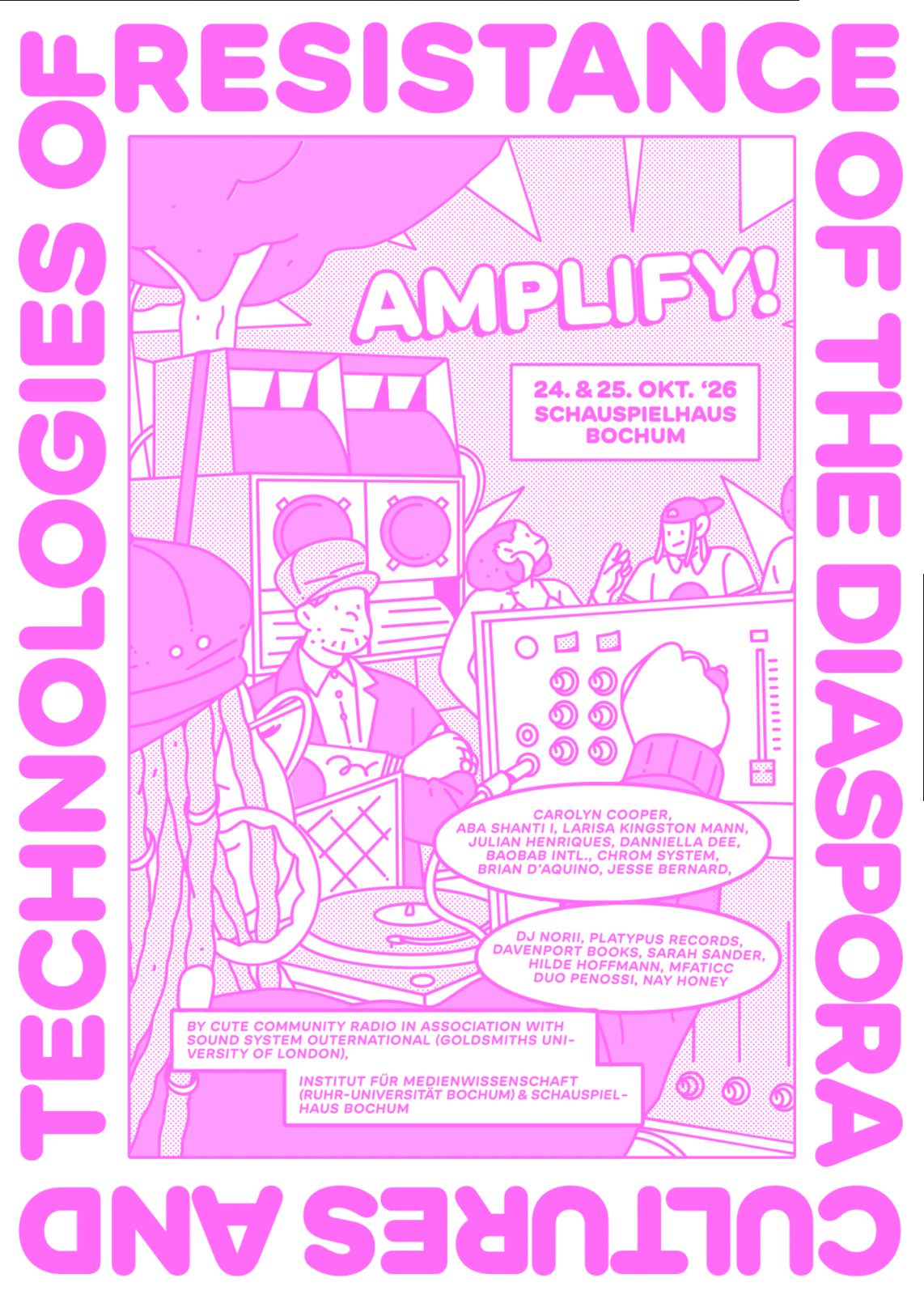
AMPLIFY! event flyer
The city of Bochum lies in the heart of what is commonly known as the Ruhrgebiet (Ruhr Area), a conglomeration of towns, among them Essen, Duisburg, Dortmund and Gelsenkirchen, which is the largest urban area in Germany. Affectionately called the Ruhrpott (Ruhr cauldron) in local vernacular, this conurbation bordered by the river Rhine in the west and the river Ruhr in the south constituted Germany’s industrial heartland after World War Two. The region around Bochum was one of the engines of Germany’s post-war ‘economic miracle’, as a result of a thriving coal-mining and steel manufacturing industry which was replaced by the Opel car manufacture once the melting furnaces and collieries began closing down during the decline of the steel industry in the late 1950s. I have fond memories of growing up in this region. I was born on the border of the Ruhrgebiet, roughly 50 kilometres from Bochum and many members of my family live and work in this corner of Germany. One of my cousins, an environmental scientist, lives in Essen, the other – having sidestepped a descent into juvenile delinquency – now works as federal police in Dortmund.
Between train attendants changing shifts I caught a conversation at Essen main station. The local vernacular felt instantly familiar – a regional sociolect entirely different from the more guttural Bavarian accent of rolling R’s that I had become accustomed to working in the south. This invited a strange sensation of feeling at home in much the same way as when I pop into my local corner shop in south London after a spell abroad. Feeling somewhat moved, I decided to dial up local legend Herbert Grönemeyer’s 1984 song Bochum – a song which resonates into the present and is seen by many locals as the unofficial hymn to Bochum.
Due to popular demand, actor and musician Grönemeyer released an English version of the song a few years after its original release, though the words don’t quite “hit” like the German original. However, his ode to the city that “loves itself without makeup,” is “fuelled by coal,” is “honest and detests corporate money” and has a “pulse of steel that can be heard loudly through the night” still feels apt, if by now also slightly antiquated – the place is still noisy, even if no steel has been produced here for more than fifty years. The local football club VfL Bochum still plays the song before every match. The economic and cultural legacy of coal mining is deeply woven into the social fabric of the Ruhrgebiet. Determined to maintain this historical memory, the cities of Bochum and Essen have preserved two former collieries and turned them into “mining museums,” where visitors can experience a mining elevator simulation and ‘descend’ down hundreds of metres into the earth. On arrival deep ‘below ground’, a guided tour takes the visitors through different epochs in the history of mining and offers the experience of handling an assortment of jack hammers and other tools.
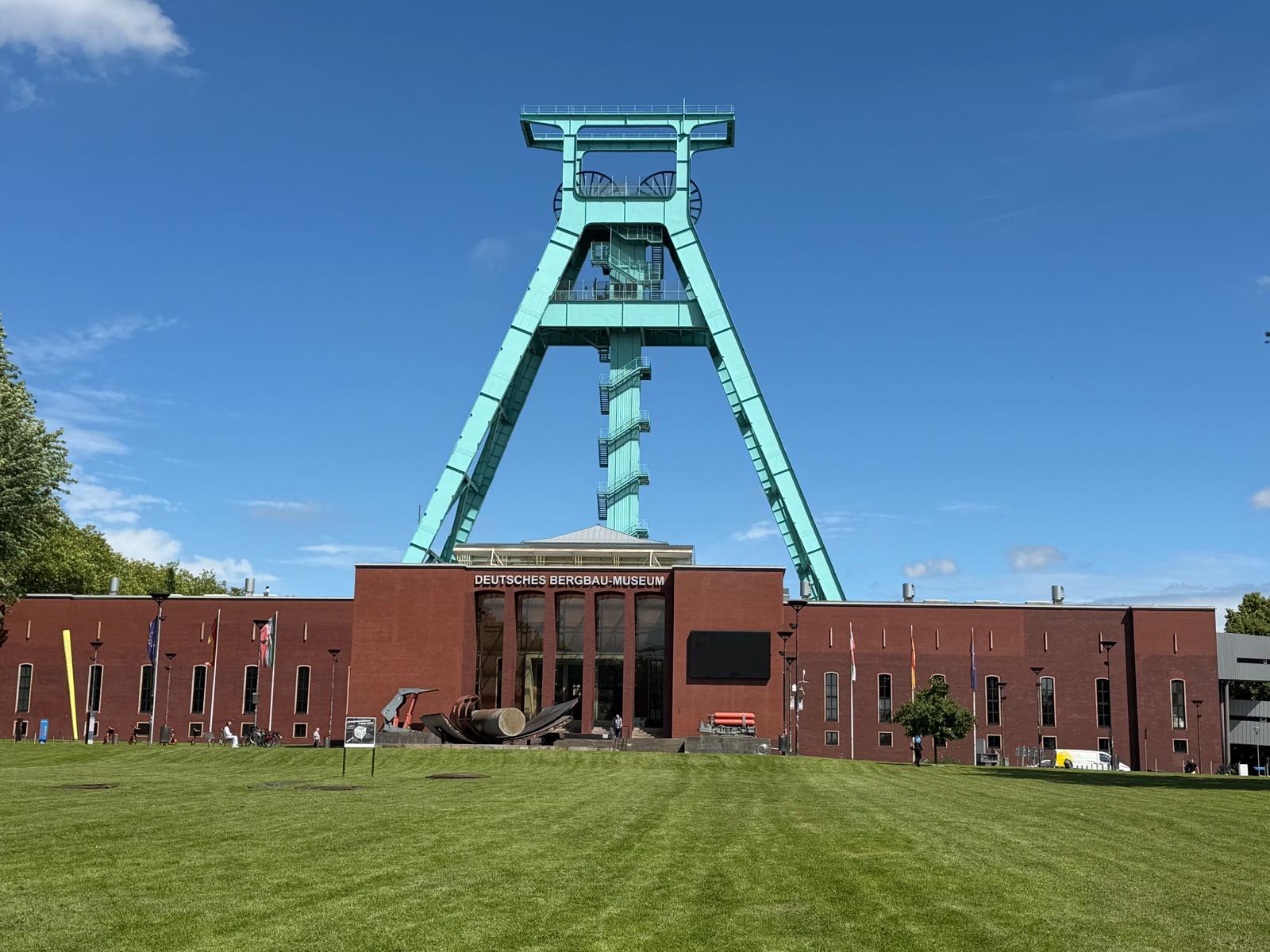
Tower at the Mining Museum
Somewhere between Duisburg and Essen the train lowered its speed as it cruised past dilapidated rail yards and abandoned factory buildings. I began reminiscing about the times in my late teens and early 20s, visiting music events and hanging out with friends in repurposed collieries such as Zeche Carl or Zeche Bochum, which had been turned into events- and exhibition spaces as a result of the structural changes initiated in the wake of the decline of heavy industry. Alongside a reorientation towards developing IT and Green Energy sectors, the Ruhr Area has transformed into one of the most culturally dense areas in Germany. A thriving creative industry has turned cities like Bochum and Dortmund into centres of art, culture and leisure activities.
Graffiti artists have turned the walls of many of the crumbling storage depot buildings bordering the rails into their galleries. In some way, the slogans speak to the spirit of the place – “No revolution without women!” or “Refugees are welcome here!” However, these progressive messages belie the spectre of the ascendant political right that has recently been gaining a foothold and began shifting the region’s traditionally centre-left and heavily unionised political outlook. There is a strange contradiction between the rise of the far-right and Bochum’s demographic. The Ruhr valley has historically been a central area for migration into Germany. In the 20th Century, the most significant of several waves of migration were the so-called Gastarbeiter, drafted into jobs in the steel plants, coal mining and later the automotive industries. These labourers from Italy, Turkey, Greece and former Yugoslavia make up a significant part of the area’s cultural makeup. The establishment of Ruhr University Bochum in the mid 1960s was another significant factor in the cultural diversification of Bochum due to the arrival of students from all corners of the world, many of whom decided to stay and make Bochum and the adjacent cities their permanent home.
The AMPLIFY! project was conceived by Guy, who had contacted Julian Henriques, head of the SSO research centre in March 2026 to enquire about a possible collaboration, highlighting that he had already established links with Ruhr University Bochum as additional stakeholders, multipliers and supporters. Julian agreed and organised an initial Zoom meeting between SSO, CUTE and RUB. The atmosphere during the call was fantastic and it quickly became clear that all the participants were singing from the same hymn sheet. The key driving force behind the project would be CUTE Community Radio (CCR) which has, over the last five years, become a significant force in consolidating Bochum’s diverse migrant community. Operating primarily as a local radio station, CCR’s remit, however, stretches far wider than that. Members of CCR have consistently been punching above their weight – while operating on a shoestring budget – in providing a cultural space for Bochum’s migrant community. While it mainly operates as a local radio station, it is at the same time an important community hub which organises talks and events, foregrounding racialised and minoritised voices from the local area. Crucially, CCR also runs and operates its own sound system. As an educational and knowledge-sharing space with a strong emphasis on community activism, CCR has struggled for recognition and, ultimately, began receiving basic funding from the local municipality and other arts funding bodies in the Ruhr area.
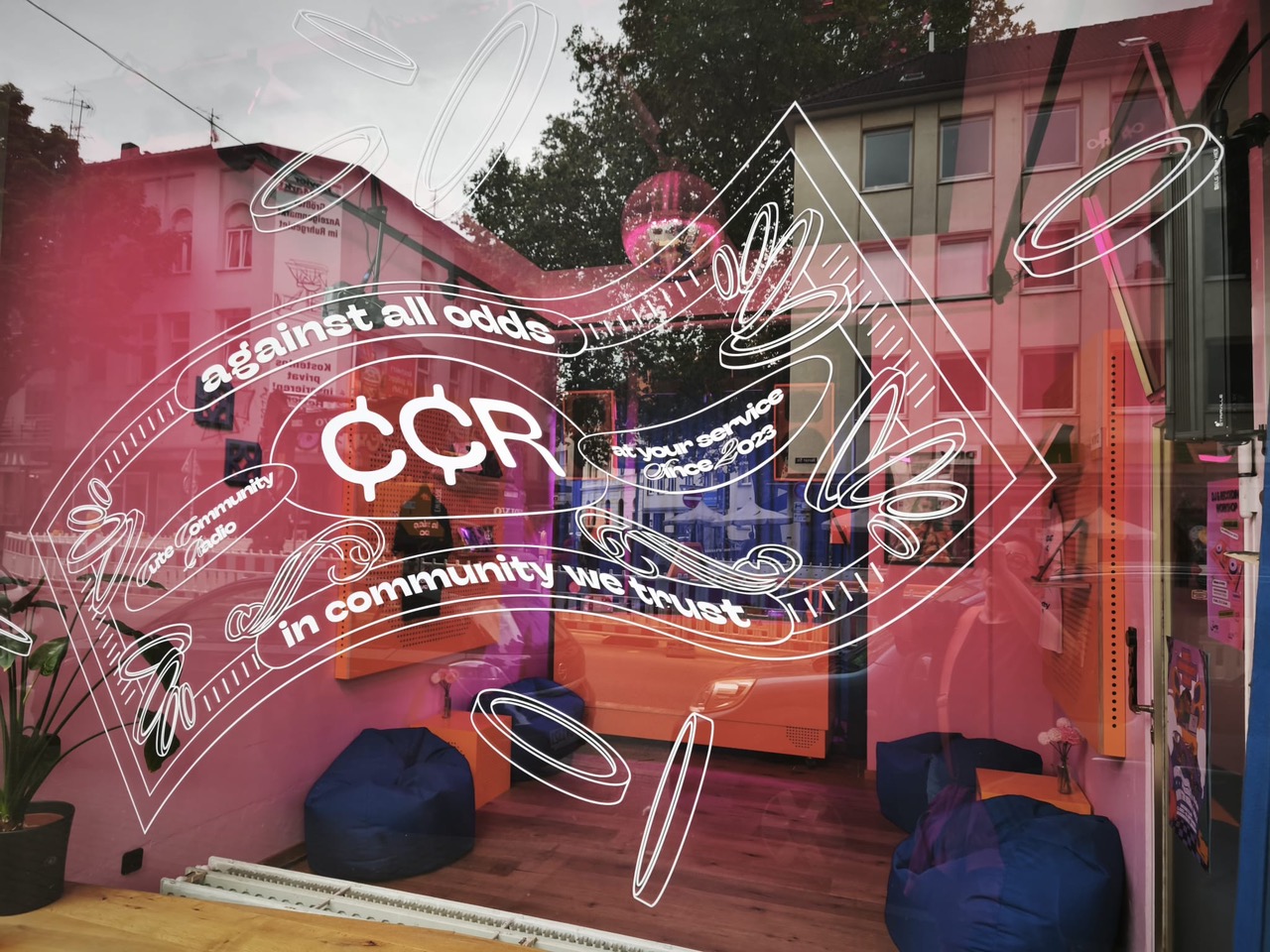
Cute Community Radio Shopfront
Over the past few years, CCR has developed close ties with the Institut für Medienwissenschaft (IfM) at Ruhr University Bochum (RUB). Under the stewardship of Dr Hilde Hoffmann and Dr Sarah Sander, the IfM has been responsible for initiating an ongoing series of events, workshops and talks under the banner MEDIA/DENKEN, which foregrounds (migrant) community activities and activism. Crucially, these events have evaded the frequently exclusivist practices of universities and reached out to and made connections with the wider cultural and artistic scenes in the Ruhr area. Emphasising the importance of the creativity and cultural politics of community activists and the regional arts and music scenes has enabled IfM and their lively and diverse student body to provide cutting edge research and interventions in Bochum and beyond.
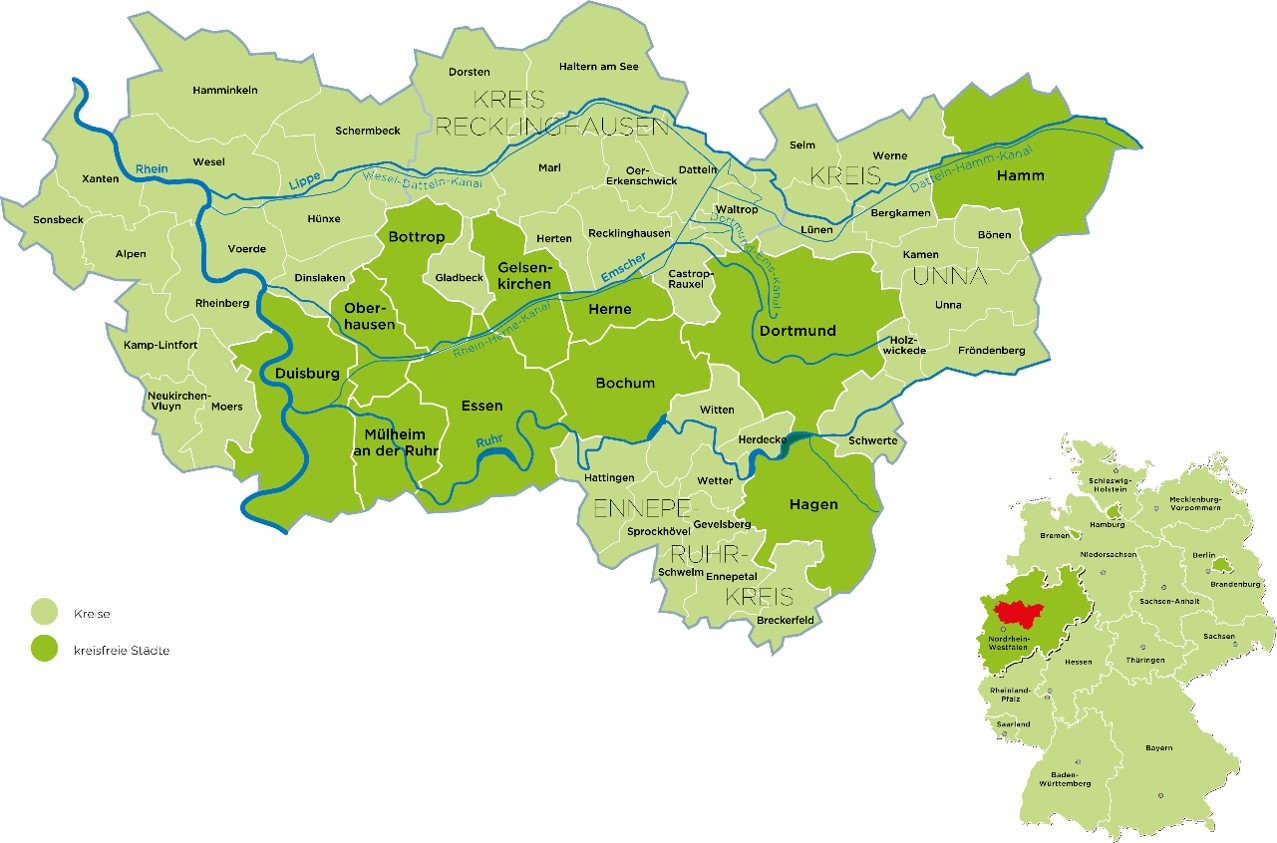
Map of Ruhr area
CCR constitutes one of the loci where the diasporic first, second, third or fourth generation migrant community with routes in a variety of countries congregates, strategises, retreats, shares and explores. Straddling the boundaries between private and public, resistance and retreat, the small shopfront in Herner Strasse has a unique cultural significance. The tiny and extremely neat “shop” is reminiscent of a microscopic music venue… or a very tidy living room. Entering the shop from the street I find myself standing in a 9 square metre miniature pit, facing the mixing desk which has two stacks of neatly painted orange PA speakers suspended from an aluminium rig above it. Two bean bags on the floor, a small bench in the alcove facing the street, CUTE community posters and a number of miniature bookshelves with a handful of “select readings” (I remember titles by Achebe and Du Bois) complete the interior décor of the room. The space strikes me as intimate and cosy on the one hand, but also profoundly “hi-tech” on the other: a laptop which features a mixing desk and a connected HD camera enable real time live-streaming. This is the bridge of the CUTE mothership, the atomic centre from whence all countercultural activity springs.
Frank Foster’s 1972 album title The Loud Minority comes to mind when trying to characterise the work and the space of CCR. After several conversations with Guy about the work, the struggles and the initiatives of CUTE, I am inclined to – indirectly – answer Spivak in suggesting that here at least, the subaltern does indeed speak. If only by releasing a volley of low frequencies into the ether, directed towards the normative structures of whiteness that are always at the ready to try and silence it.
It is in this magical Lilliputian space that our pilot meeting takes place on this warm and sunny June afternoon. At around 4pm, Hilde and Sarah arrive, having made their way via Bochum’s small metro network from the university campus. They arrive with a group of students some of whom are deeply invested in the work and political ethos of CUTE and have been attending – or running – events here for several years. Most of them also proudly hail from a – to misappropriate official German political discourse – “migration background.” The CUTE students run things and are proud to claim and show off their space.
For the occasion, Guy has transformed the covered driveway leading from the street to the inner courtyard into a tiny lecture theatre, which is completed by two rows of chairs, a projector and a raised platform. He nods to me in passing and smiles – “CUTE University,” he quips, and I can’t help but agree. This initial event reflects the incredible energy and frontier spirit generated by the collaboration between CUTE, SSO and RUB. While more people trickle in, there is lively chatter all around. Israel Vibration’s Unconquered People echoes from the speakers as people begin to sit down in the driveway lecture theatre and inner courtyard to listen to the introductions. The atmosphere is joyous and convivial. As they sip on their shandys and off-brand colas or take a puff on their rollups, the attendees appear to look forward to what is about to happen…
References
Achebe, C. (2006) Things Fall Apart London: Penguin Classics
Spivak, G. C. (1988) ‘Can the subaltern speak?’ in Nelson, C. and Grossberg, L. (eds.) Marxism and the interpretation of culture Champaign: University of Illinois Press
Du Bois, W.E.B. (1989) The Souls of Black Folk New York: Penguin Books
Frank Foster – The Loud Minority – https://www.youtube.com/watch?v=gD4JZMZCouA
Grönemeyer – Bochum – https://www.youtube.com/watch?v=OvauzdH0fHY
Israel Vibration – Unconquered People – https://www.youtube.com/watch?v=VBhEFMGmO2E&list=PLmqOXNgbKfiNxX1kUuhNOekrvxgx5k53I&index=7
About the Author
Thomas Zacharias is a Lecturer at Goldsmiths, University of London. He completed his PhD in Sociology, which examined racism in left-wing German political discourse, more than a decade ago. He has subsequently worked across the departments of Sociology, Education, and Media and Cultural Studies.