
WRITING HISTORIES THROUGH SOUND IN BOGOTA’, COLOMBIA
The insurgent sonic practices of sound systems and other sonic street technologies not only provide entertainment for local and marginalised communities, but actively reconfigure the urban space, reflecting and reshaping shifting identities and emerging spaces of sonic possibility.
In anticipation of his forthcoming book chapter in the Mobile Music Machines edited series, this blog by Colombian researcher Edgar Benítez Fuentes traces the ways in which sound systems and picós converge in Bogotá, Colombia’s capital — simultaneously transforming the city while being transformed by it.
by Edgar H. Benítez Fuentes
Conducting research on sound system culture in Bogotá is, in a sense, an exercise in re-learning how to listen to the city. Not an abstract or cartographic city, but a concrete Bogotá that vibrates, reverberates, reshapes itself and tenses each time a tower of bass boxes is turned on in a park, or a migrant picó lights up the night in Suba, Bosa or Kennedy. The initial research question—how these sonic street technologies are built, what they mean, and how they are lived on the Andean plateau—gradually turned into an emotional, technical and political journey that continues to move me deeply.
This blog is a chronicle of this research process. It is not a summary of my forthcoming book chapter, but rather an account of how a particular understanding took shape through listening to sound systems, attending sessions, walking through the city and sustaining long conversations with those who build, operate and defend these sonic practices. It is also an exercise in personal memory.
I belong to picotera culture, to the slopes of La Popa in Cartagena, where the local sonic street technology, el picó, has always meant street, celebration and community. Although I was familiar with the history of reggae sound systems and their Afro-Caribbean and diasporic genealogies, for a long time I had never actually experienced one. Like many others, I initially thought of them as something akin to modern picós fraccionados. Over time, however, I came to realise that, although these practices intersect and remain in dialogue, their musical, technical, and political logics unfold along distinct trajectories that converge and are reconfigured in Bogotá.
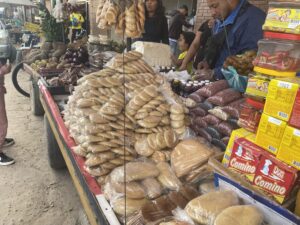
Panela, bollos, grains, and fruits from Colombia’s Caribbean region sold through informal street vending in Bogotá. Like sound systems and picós, these food practices materialise the Caribbean diaspora within the Andean metropolis.
Years ago, together with other friends from Cartagena, we had the opportunity to bring the UK veteran Channel One sound system to La Heroica, through connections forged in Bogotá and with the mediation of Ricardo Vega from El Gran Latido sound system. That encounter opened lasting conversations about sound system culture, the need to build a rig in Colombia, and the parallels and differences with our picotera history. We also had the chance to take these artists to La Boquilla—a fishing village—and to the Bazurto market, a hub for the local popular culture and the 1990s champeta music in Cartagena. Later on, already in Bogotá, I found myself at Latino Power in Chapinero, celebrating the inauguration of El Gran Latido: a massive stack of speakers playing reggae and dub, sustained by a level of technical dedication and a collective ethic that felt deeply familiar.
Witnessing the passion of selectors in Bogotá reminded me of the affective relationship that exists on the Caribbean coast with African music, salsa, and the sounds of the wider Caribbean as played by the picós. From that point on, my interest grew organically, in step with attending sessions, extended conversations, and the opportunity to connect my research interests with cultural processes unfolding in a city located 2,600 metres above sea level. The text that emerged from this research brings together these reflections: interviews, street-based learning, engagements with Black Atlantic scholarship, cold Bogotá nights, and a series of community gestures that were less about data than about signals of friendship, trust, and shared worlds.
Moreover, this blog also reflects on how research is conducted in a city that sounds—and that often defends itself through vibration.
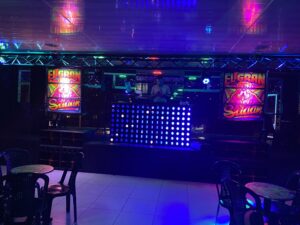
El Gran Suan, a fraccionado-style picó sound system based in El Rincón, Suba district, Bogotá, 2024. Photograph taken as part of the fieldwork (2024).
The first bass drop that reorganises the world
Every research process has its epiphany: that moment when the body understands before the mind. Mine occurred in a dancehall in Chapinero, on a cold November night, when El Gran Latido sound system played for the first time. Solid wood, a 5-ways rig, and a bass that did not roar but seemed to breathe, rearranged something in my chest. It was an intense night, shaped by sounds from the United Kingdom (Channel One sound system, the guest artist), charged with history, spirituality and political reflection. Midway through the session, a track led by horns sealed the infatuation.
Over time and through fieldwork, an idea emerged repeatedly and eventually came to organise the entire research project: sound systems in Bogotá do not operate as a cultural trend, nor as a mere technical device, nor as an enclosed music scene. They function as community projects, as ways of inhabiting the city and building relationships through sound.
Throughout the research process, sustained conversations with Ricardo Vega (El Gran Latido sound system), Diego Pedraza (Culture United sound system), members of Fuego Negro sound system, Leo Suárez (El Viejo sound system), Diana León (La Comadre sound system) and Uranis Alberto Rojas (Picó El Talismán) were fundamental to understanding how these sonic practices are built, negotiated and sustained in the city.
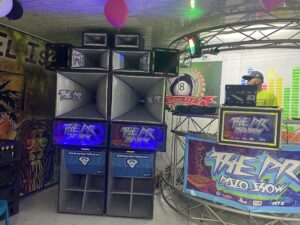
The PR Disco Show, a fraccionado-style picó installed in a billiard hall in El Rincón (Suba). Migrant picó culture reconfigured within Bogotá’s nocturnal circuits.
Bogotá as a converter of musical energies
Bogotá does not act here as a backdrop. It functions as a converter: an urban machine that distorts, translates and reinvents everything that arrives. Music, bodies, migrations, technologies, accents, aesthetics and desires are reconfigured upon entering the city.
The reggae sound system, with its Afro-Atlantic genealogy, arrived in Bogotá comparatively recently, in fragmented form and through multiple transnational circuits. Yet in the city it has had a long, and often untold, history since the 1980s, if not earlier. The picó, by contrast, is the result of internal migration from the Colombian Caribbean coast: suitcases loaded with memory, nostalgia, records, and the desire to dance. It settled in bars, billiard halls, and peripheral clubs, and today pulses in neighbourhoods with a strong coastal presence, where battered accents mix with the capital’s familiar “hola, veci”.
Both sonic street technologies encountered an unexpected condition in Bogotá: the constant need for translation. The city forces a reinvention of the aesthetics, techniques and politics of sound in order for these practices to exist. This process of translation—full of tensions, negotiations and learning—became the core of the research.
Initially, my concern centred on how Jamaica sounded—often filtered through Europe—in an Andean city. Fieldwork quickly corrected this intuition. The real question became something else: what makes it possible for bass frequencies to become community in a city designed to monitor, restrict, and, in many cases, expel them?
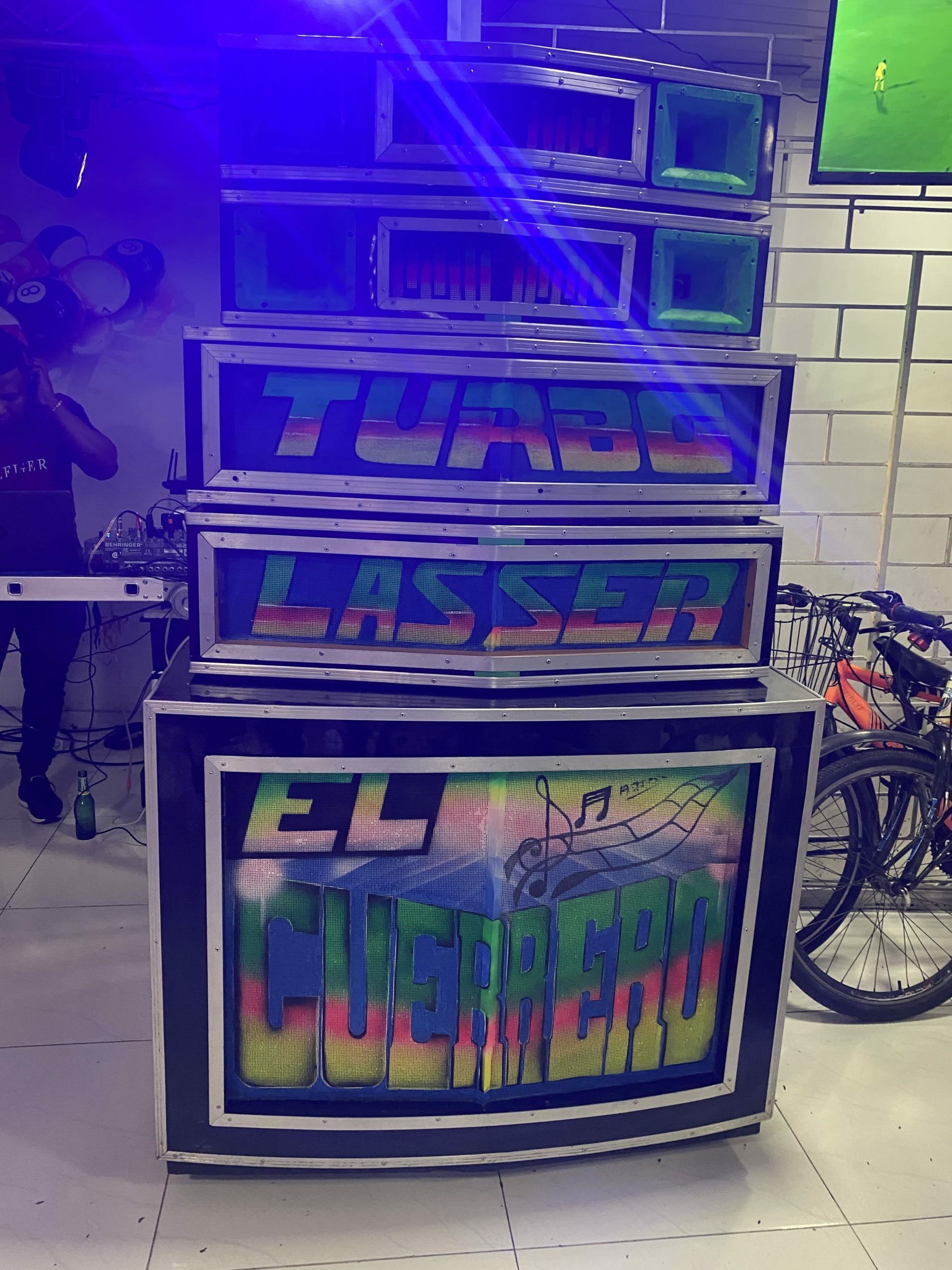
El Guerrero Turbo Lasser, a Turbo-style picó active in El Rincón, Suba. An example of the adaptation of Caribbean picó tradition to enclosed spaces at 2,600 metres above sea level.
Bogotá is a harsh city, marked by deep inequalities, that wakes before dawn to sustain economies that benefit only a few. In this context, loud, free, and collective sound is unsettling. Readings of Stuart Hall, Paul Gilroy, and Julian Henriques helped to give theoretical form to what the street was already expressing: identity is not essence but articulation; diaspora is a route rather than a root; and sound is a form of embodied, political knowledge.
Bogotá does not imitate the sound system, nor does it replicate the picó. It translates them. Through this translation, specific forms of sonic citizenship emerge. Conducting fieldwork in this scene is an exercise in ethnography in motion: nothing stands still. The street operates simultaneously as classroom, laboratory, and space of negotiation. One of the central lessons was the realisation that building a sound system is not only about playing music; above all, it is about making the city.
Throughout walks in Suba, Fontibón, Chapinero, el Centro and interviews with practitioners, a constant concern emerged around care for public space. In the case of sound systems, the street is not understood merely as a place to sound, but as a territory that must be respected, explained and collectively sustained. At sessions, this ethics of care translates into pedagogy with neighbours, time protocols, conscious volume control, cleaning of the space, and a permanent disposition towards dialogue. Making a system sound thus entails a responsibility towards the environment and those who inhabit it.
A walk with friends from the Colombian Caribbean coast to Suba exploring the venues where picós play also formed a fundamental part of the research. Billiard halls, taverns and dark clubs have become the primary spaces where picós thrive at 2,600 metres above sea level. These are places marked by constant negotiation, discretion and adaptation, where the party does not disappear but withdraws and becomes less visible. In these venues, the traditional social aesthetics of the picó have undergone profound transformations: from the wide-open spaces of Caribbean streets to small, dark bars where little is said and few wish to appear in photographs. This spatial contraction is accompanied by a sonic transformation. Alongside classic African sounds, champeta and hard salsa, picós in Bogotá have had to combine their traditional repertoire with “crying” vallenato, reggaeton and Colombian popular music.
And yet, at sound system street sessions, the scenes repeated themselves: spontaneous conversations during events; children dancing while their mothers sold coffee; elderly people approaching to talk about their vinyl collections—rancheras, tango, tropical music—and about other times of listening.
Both in these open encounters and in the enclosed spaces inhabited by picós, sound activated dormant sonic memories and produced unexpected encounters, demonstrating that beyond location, these sonic practices have the capacity to convene, connect and reorganise the social.
From interviews and conversations with sound system owners, recurring ideas emerged: sound as a form of neighbourhood communication; aesthetics as an invitation to enter without fear; patience as part of the craft; technique as collective learning; recycling and repair as political practices; and the picó as a way of life that migrates with people. My research took shape from there, more through the accumulation of shared experiences and reflections than through the application of closed conceptual frameworks.
Readings of Stuart Hall, Paul Gilroy, Brendon LaBelle, and Julian Henriques did not impose an order from above. Rather, they provided words for what was already unfolding. Identity appeared as a contested process; bass as a traveler along Atlantic routes, now crossing the Colombian savannah; sound as an affective technology; and public space as an acoustic territory rather than a visual field.
In the everyday practice of Bogotá’s sound systems, a shared ethics became evident: negotiate rather than impose, explain rather than confront, do collectively rather than compete. The refrain, repeated in multiple forms, was clear: doing it together is better.
A central aspect of the research process was recognising the active participation of the sound systems in recent social mobilisations in Bogotá. In these contexts, speaker stacks do not function solely as musical devices, but as sonic infrastructures of protest. This political dimension of sound speaks directly to the transatlantic trajectories that run through the text. Just as in other Black Atlantic contexts sound has been a tool of resistance, communication and survival, in Bogotá the sound systems have become integrated into contemporary urban struggles.
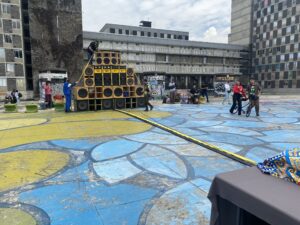
Culture United SS and Sampling Dub SS during the set-up for the 4:20 event, organised by www.radioital.com, at Plaza de La Hoja (Bogotá, 4 April 2024). Before the sound begins: the collective labour that enables sonic architectures in the urban space.
Writing about sound entails at least two major challenges. The first is sensory translation: how to put into words something felt more in the stomach than in the ear. The second is the urban context. In Bogotá, regulation often turns bass into “noise”, and this label is not neutral. It defines which sounds are acceptable and which are not.
During fieldwork, I experienced situations that starkly exposed these sonic hierarchies. At an international art event in Bogotá, where I was invited to participate musically, repeated tensions arose around which sounds were deemed appropriate for the institutional context. On several occasions, picotera music, salsa, champeta and African sounds were displaced in the name of a supposed sonic neutrality associated with so-called “chill out”. The experience made it clear that the conflict is not only acoustic: it is cultural, racial and deeply political.
In response, crews develop strategies of trust: pedagogy, dialogue, flexibility and care for the environment. These practices, far from being logistical details, constitute a genuine grassroots cultural politics.
Writing this work yielded several lessons. The first is that sound boxes organise community—not as metaphor, but as concrete practice that brings together bodies, trajectories, neighbourhoods and migrations. The second is that technique is political: wiring, measuring, orienting boxes and modulating voices builds coexistence. The third is that Bogotá is more Caribbean than it often admits. The city vibrates with migrant, displaced and marginalised musics that have found new futures here.
Many stories remain untold and deserve chapters of their own: the carpentry workshops where boxes are built, the relationships between street graffiti and street sounds, the tensions between party and protest, and the emerging urban sonic archive. The participation of women in sound systems is not an absence, but a line already developed in other projects, particularly with La Comadre sound system and its Amplificadas project, which directly dialogues with this research.
Therefore, the outcome of such a research trajectory is not merely an academic article. It is an ongoing process of documenting, recording, writing and returning to the scene what the scene itself shares.
In the end, researching Sound Systems and picós in Bogotá is to participate—however laterally—in a community that vibrates with a simple and powerful ethic:
doing together, sounding together, caring together.
That is the true finding.
About the author:
Edgar H. Benítez Fuentes is an anthropologist, archaeologist, DJ and selector. Based in Bogotá since 2015, he is dedicated to music research and, as a selector, to honouring and amplifying Afro-diasporic culture.